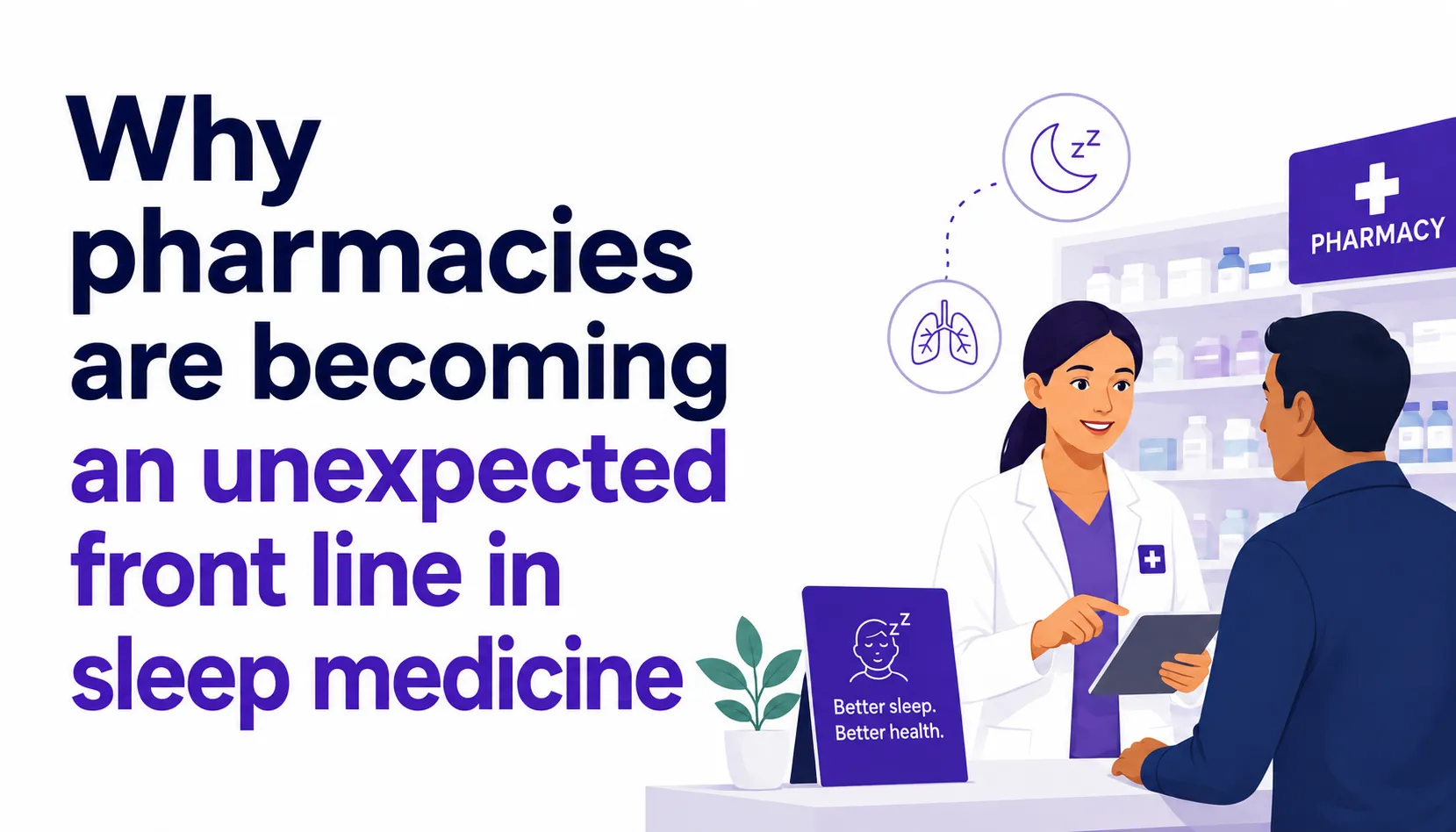
Pharmacies see the exact patients most likely to have undiagnosed sleep apnea, every single day. Here's why that matters right now.
For many people, healthcare does not begin in a specialist's office. It happens while picking up a prescription, during a conversation about blood pressure, when starting a new weight-management medication, or in one of the many routine interactions people have with their local pharmacy.
That matters because some of the health conditions pharmacists encounter every day overlap significantly with obstructive sleep apnea (OSA). And yet, sleep health often remains disconnected from the everyday healthcare conversations happening around those conditions.
That disconnect creates an opportunity. Not for pharmacies to become sleep clinics, but for pharmacies to become an important engagement point for sleep health, helping more people recognize that sleep may be worth paying attention to, learn about their sleep health, and take an informed next step when appropriate.
The overlap pharmacies see every day
Consider the populations pharmacies already serve. A patient may visit regularly for antihypertensive medication. Another may be managing type 2 diabetes. Someone else may be beginning a weight-management program, or receiving medications related to cardiovascular disease.
These may look like separate healthcare journeys, but from a sleep-health perspective, there can be meaningful overlap. The American Heart Association has highlighted the high prevalence of OSA among people with several forms of cardiovascular disease and recommends greater attention to OSA in populations including those with resistant or poorly controlled hypertension and recurrent atrial fibrillation.¹
The relationship extends into metabolic health as well. OSA is a frequent comorbidity among people with type 2 diabetes, while obesity is an important risk factor for OSA.² That does not mean every person with one of these conditions has sleep apnea, but it does mean that pharmacies are routinely interacting with populations for whom greater sleep-health awareness may be valuable.
Unlike many specialist settings, pharmacies also have recurring opportunities to engage the same individuals throughout their healthcare journey. That creates something healthcare systems frequently need more of: an opportunity to engage people where they already are.
Historically, sleep apnea has often been viewed primarily through the lens of sleep medicine. Symptoms raise concern, an appropriate clinical evaluation follows, diagnostic testing is performed when indicated, and treatment options are considered. That clinical process remains essential, and the American Academy of Sleep Medicine recommends that diagnosis of OSA be based on a comprehensive sleep evaluation and appropriate objective testing rather than questionnaires or prediction tools alone.³
But the broader context around sleep health is changing. Sleep increasingly intersects with conversations about cardiovascular health, metabolic health, obesity, and chronic disease management. A particularly visible example came in 2024.
Two phase 3 SURMOUNT-OSA trials published in The New England Journal of Medicine evaluated tirzepatide in adults with obesity and moderate-to-severe OSA. The trials found improvements in measures including apnea-hypopnea index, body weight, hypoxic burden, systolic blood pressure, and patient-reported sleep outcomes.⁴
In December 2024, the U.S. Food and Drug Administration approved Zepbound (tirzepatide) for moderate-to-severe OSA in adults with obesity, alongside a reduced-calorie diet and increased physical activity. This was the first FDA-approved medication for this specific indication.⁵
The significance for pharmacies goes beyond a single medication. It reflects a broader shift where sleep health is becoming increasingly connected to healthcare journeys that already involve pharmacists, primary care providers, obesity-management teams, dentists, and other healthcare professionals outside traditional sleep clinics. As those connections become more visible, an important question follows: how can healthcare organizations help people recognize those connections earlier?
This distinction is important. A pharmacy does not need to diagnose sleep apnea to play a meaningful role in sleep health. It does not need to determine whether someone needs PAP therapy, an oral appliance, medication, surgery, or another intervention. Those decisions belong within appropriate clinical evaluation and care.
AASM guidance specifically emphasizes that clinical tools, questionnaires, and prediction algorithms should not be used on their own to establish an OSA diagnosis.³ The pharmacy opportunity comes earlier than that.
It is the opportunity to help create the moment when someone thinks, "maybe my sleep is something I should pay more attention to." That moment may sound simple, but it can be an important step in the healthcare journey. People do not act on health issues they have never considered, they do not ask questions about connections they do not know exist, and they are less likely to seek further evaluation if sleep health has never felt personally relevant.
This is where pharmacies have an advantage. They already have the consumer's attention, they already have a healthcare context, and in many cases, they already have a natural reason to introduce a broader conversation about health and wellbeing. The goal is not to turn the pharmacy counter into another clinical testing environment. The goal is to make sleep-health engagement easier to initiate.
A pharmacy-enabled sleep-health journey does not have to be complicated. Imagine someone visiting a pharmacy as part of their regular healthcare routine, perhaps managing hypertension, receiving treatment related to diabetes or weight management, or engaging with a broader pharmacy health and wellness campaign.
At that touchpoint, the individual is invited to explore their sleep health through a QR code, tablet, pharmacy app, digital communication, or another consumer-facing experience. Instead of immediately entering a clinical process, they begin with an interactive experience designed to make sleep health understandable and personally relevant.
They learn, they engage, and they begin to connect aspects of their health, sleep, and individual characteristics in a way that may not have occurred to them before. When appropriate, they can be encouraged to continue the conversation with a qualified healthcare professional.
The journey becomes: everyday healthcare interaction, sleep-health engagement, personalized education, and informed next step. The pharmacy is not replacing the sleep physician. It is helping create a bridge to greater awareness.
Simply putting up a poster saying "ask us about sleep apnea" is unlikely to transform sleep-health engagement. People need a reason to participate, and the experience has to feel relevant to them. That is where digital tools can change the equation.
Instead of relying exclusively on staff to initiate every conversation, pharmacies can give consumers a private, interactive way to explore sleep health themselves. A QR code can extend an in-store interaction onto the consumer's own phone. A digital campaign can connect a medication or chronic-care journey with sleep-health education. A pharmacy app can make sleep health available alongside other wellness services.
This matters operationally as well. For pharmacy organizations operating across dozens, hundreds, or thousands of locations, a sleep-health initiative cannot depend on every staff member delivering the same lengthy conversation. The engagement layer needs to be simple for the pharmacy, consistent for the consumer, and scalable across locations and digital channels.
That is a fundamentally different challenge from delivering clinical sleep care, and it requires a different kind of solution.
This is the role the FaceX AI selfie experience for sleep wellness is designed to support. FaceX by Soliish is an AI-powered platform built around an interactive selfie experience, allowing individuals to engage using something already familiar to them, their own face, along with questionnaire-based information to explore personalized sleep-health insights.
The purpose is not to diagnose sleep apnea. It is to make sleep health personal enough to earn attention. Rather than presenting consumers with generic education, FaceX creates an interactive experience that helps them learn about facial characteristics and other information related to their sleep health.
That experience can support awareness, education, and a more informed conversation about what they may want to do next. For pharmacies, this creates several potential deployment models: an in-store QR code, integration into a pharmacy's digital health or wellness experience, complementing conversations around chronic disease or weight management, or forming part of a broader sleep-health program connecting pharmacies with other healthcare partners.
The underlying idea remains the same. Bring the engagement experience to the consumer instead of waiting for the consumer to find sleep medicine on their own.
The most interesting opportunity for pharmacies is not adding "sleep apnea" as another condition to manage. It is connecting healthcare conversations that have historically happened in isolation.
Blood pressure and sleep; metabolic health and sleep; weight management and sleep; cardiovascular health and sleep; medication management and overall wellbeing. The clinical evidence increasingly reinforces these connections, with OSA carrying important associations with cardiovascular disease and cardiometabolic health, and obesity and type 2 diabetes frequently intersecting with sleep apnea.¹˒²
The pharmacy already sits at the center of many of these conversations. A thoughtfully designed sleep-health engagement strategy can help make the connections more visible to consumers without asking pharmacists to become sleep specialists. That is an important distinction, because the future of sleep health will not be created only by adding more clinical capacity. It will also depend on creating more opportunities for people to become engaged before they reach a sleep clinic.
Healthcare organizations often search for entirely new channels through which to reach consumers. In sleep health, one of the most useful channels may already be part of people's routine: the neighborhood pharmacy, the retail pharmacy app, the medication pickup notification, the chronic-care conversation, the weight-management journey.
These are not replacements for clinical sleep medicine. They are opportunities to bring sleep health closer to everyday healthcare. As sleep becomes increasingly connected with cardiometabolic health, obesity care, and broader wellbeing, pharmacies may be well positioned to help more people begin that conversation.
Not by diagnosing or not by prescribing a sleep-health pathway, but by making sleep health easier to notice, easier to explore, and easier to act on. The next major opportunity in sleep health may not come from asking people to find another healthcare destination. It may come from bringing meaningful sleep-health engagement into the healthcare interactions they already have.