What is AHI, how is it measured, and what do the numbers actually mean? A clear guide to the apnea-hypopnea index and how it classifies sleep apnea severity.
If you have had a sleep study, or if you know someone who has, you have probably seen a number called AHI on the report.
It usually shows up as a single figure with a decimal point, and it drives a lot of what happens next. Whether you get a diagnosis. What kind of treatment gets recommended. Whether your insurance covers therapy.
For a number that carries this much weight, AHI is often poorly explained to patients. Here is what it actually is, how it is measured, and what the numbers mean.
What is AHI, the apnea-hypopnea index?
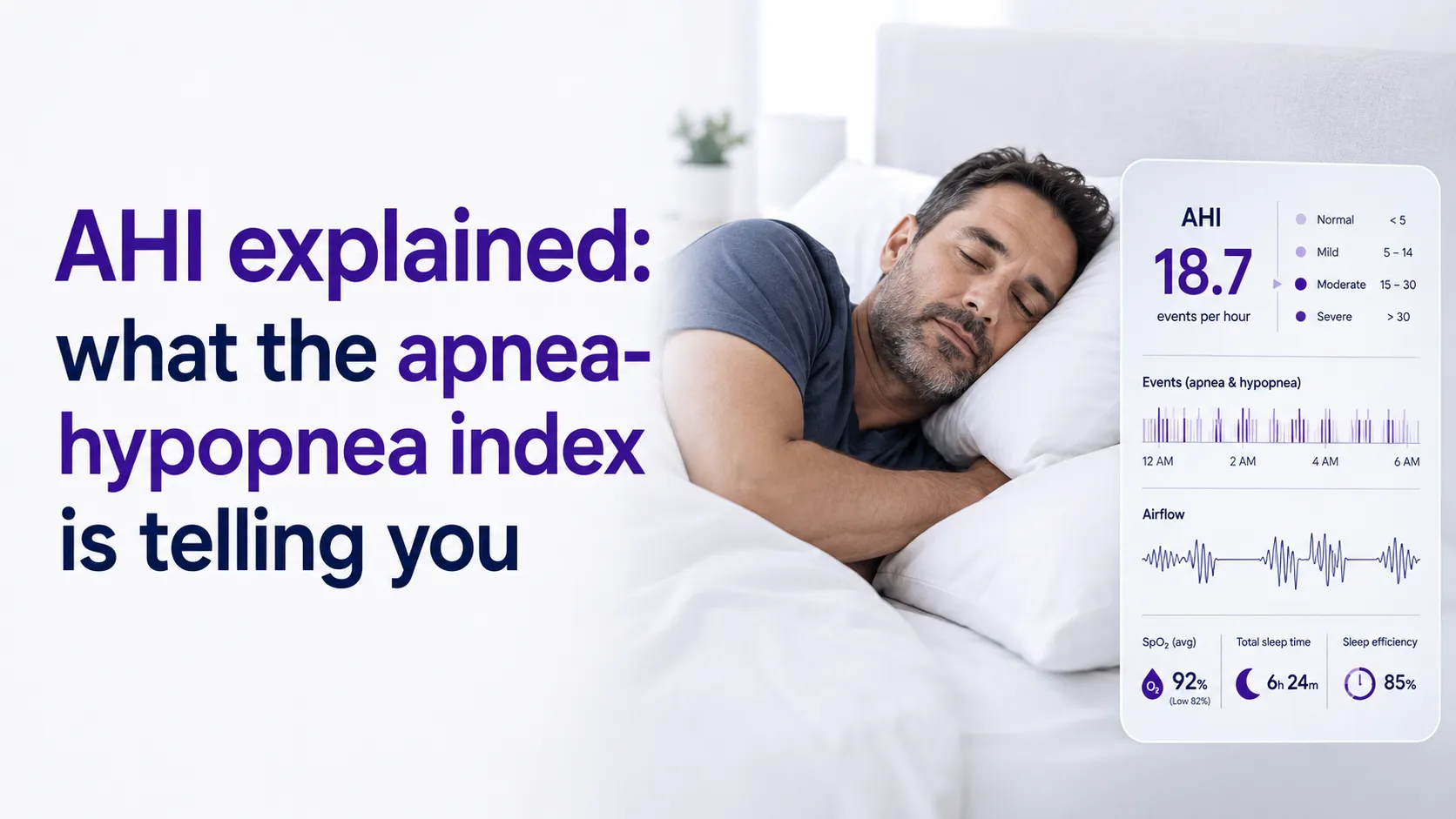
The apnea-hypopnea index, or AHI, is the number of times per hour your breathing stops or partially stops during sleep.
It combines two types of events. Apneas are complete pauses in breathing lasting at least 10 seconds. Hypopneas are partial reductions in airflow of at least 30 percent, also lasting at least 10 seconds, that typically come with either a drop in blood oxygen or a brief arousal from sleep.
Adding both types together and dividing by the number of hours of sleep gives you the AHI. If you had 40 events across 8 hours of sleep, your AHI would be 5.
The American Academy of Sleep Medicine sets the standard for how these events are scored, and the AHI is the primary number sleep physicians use to determine whether obstructive sleep apnea is present and how severe it is.
AHI is measured during a sleep study, either in a sleep lab (polysomnography) or at home (home sleep apnea test).
During the study, sensors track breathing patterns, airflow, blood oxygen levels, and sometimes brain activity and body position. Every event that meets the definition of an apnea or hypopnea gets scored by a trained technician or an automated system that is then reviewed.
The total number of events is then divided by the total hours of sleep to produce the AHI. Simple math, but the accuracy depends entirely on the quality of the sleep study and how carefully the events are scored.
Home sleep apnea tests often underestimate AHI slightly compared to in-lab studies, because they do not measure brain activity and cannot distinguish sleep from wakefulness as precisely.
AHI numbers fall into standardized categories that the American Academy of Sleep Medicine uses to classify sleep apnea severity in adults.
These thresholds apply to adolescents and adults aged 13 and older. Children under 13 are assessed on a different scale, because their airways are more sensitive to disruption. In pediatric patients, an AHI of 1 or above can be considered abnormal.
The number itself is important, but the treatment decision is usually based on the AHI combined with symptoms, oxygen levels during sleep, and other health factors.
The AHI cutoffs matter because they determine whether someone gets a formal sleep apnea diagnosis and what treatment options become available.
Someone with an AHI of 4.5 does not officially have sleep apnea, even if they have loud snoring, daytime fatigue, and every other symptom of the condition. Someone with an AHI of 5.5 does officially have sleep apnea, even if they feel fine.
The cutoffs are useful, but they are not perfect. A person just below the threshold can still have real airway problems during sleep, particularly if they have upper airway resistance syndrome, which does not show up as full apneas or hypopneas.
The cutoffs also drive insurance coverage. In many cases, therapies like CPAP or oral appliance therapy are covered when the AHI is above a certain threshold and are less likely to be covered below it.
A lower AHI is generally better, but the number does not tell the whole story on its own.
Two people can have the same AHI and have meaningfully different experiences. One might have events that cause significant oxygen drops. The other might have events that are shorter and less disruptive. AHI treats these the same, even though the health impact can differ.
Some sleep events also do not count toward the AHI at all. Respiratory effort-related arousals (RERAs) are brief awakenings caused by airway narrowing that does not quite meet the hypopnea criteria. These affect sleep quality but are not included in the AHI, which is why some people with normal AHI still have significant sleep issues.
This is why sleep physicians look at the AHI alongside oxygen desaturation data, arousal indices, and the patient's symptoms rather than treating the AHI as the only number that matters.
A borderline AHI, sitting close to a diagnostic threshold, is common and often worth a second look.
Someone with an AHI of 4.8 or 5.2 falls right at the boundary between normal and mild. The clinical decisions here often depend on symptoms. If the person has significant daytime fatigue, morning headaches, or other symptoms of sleep-disordered breathing, the physician may recommend treatment even at an AHI that would otherwise be considered borderline normal.
If a follow-up sleep study is ordered, the AHI may shift slightly. Sleep is variable, and a single study is a snapshot. Repeat studies can show meaningfully different numbers, particularly when body position, alcohol intake, and sleep quality vary.
For patients whose symptoms strongly suggest sleep apnea but whose AHI keeps landing in the borderline range, a more detailed evaluation, including looking at RERAs or considering upper airway resistance syndrome, is often the right next step.
AHI can change, and often does, based on several factors.
Weight changes tend to move the AHI in both directions. Weight loss can lower AHI, sometimes substantially. Weight gain tends to raise it.
Sleep position matters. Many people have higher AHI when sleeping on their back and lower AHI when sleeping on their side. Some have positional sleep apnea where the difference is dramatic.
Age tends to gradually increase AHI over time, especially in adults over 60. Hormonal changes, including menopause, can also affect AHI in women.
Treatment obviously changes AHI. Effective CPAP therapy or a well-fitted oral appliance can bring AHI down substantially, often into the normal range.
AHI is the primary number sleep physicians use to diagnose sleep apnea and determine its severity, but it is not the whole story.
Understanding what it measures helps make sense of sleep study reports. A number below 5 means no formal sleep apnea diagnosis. Numbers between 5 and 30 signal mild to moderate cases. Numbers above 30 indicate severe sleep apnea.
The number matters, but so do symptoms, oxygen levels, and how the patient actually feels. A conversation with a sleep physician is the way to interpret AHI in the full context of the patient's health, not as an isolated figure on a report.
If you have not yet been formally evaluated and are wondering whether sleep apnea might be part of what you are experiencing, the FaceX AI selfie experience by Soliish uses facial analysis and a short set of questions to help you learn about factors related to your sleep and think through what to discuss with a qualified healthcare professional.