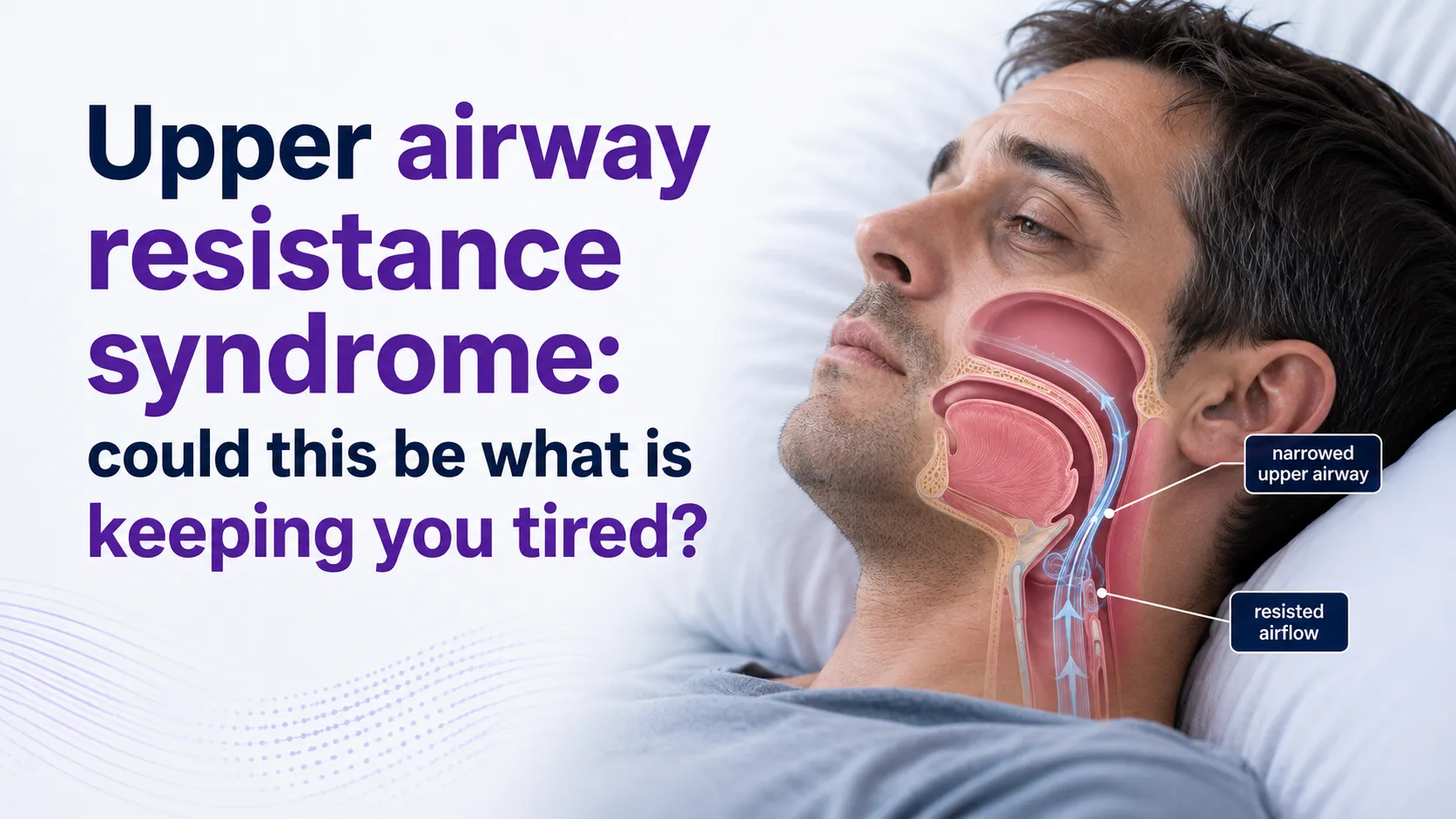
Upper Airway Resistance Syndrome (UARS) is a form of sleep-disordered breathing that often goes undiagnosed. Here is what it is and why it matters.
If you feel exhausted despite sleeping enough hours, and a sleep study has told you that you do not have sleep apnea, there is another condition worth knowing about.
Upper Airway Resistance Syndrome (UARS) affects people who have breathing difficulties during sleep that are real, but too subtle to meet the diagnostic threshold for obstructive sleep apnea. The result is often years of chronic fatigue, brain fog, and unexplained tiredness that traditional sleep testing does not catch.
Here is what UARS is, how it differs from sleep apnea, and why it matters.
What is Upper Airway Resistance Syndrome?
Upper Airway Resistance Syndrome(UARS) is a form of sleep-disordered breathing where the airway narrows during sleep but does not fully collapse.¹ The narrowing causes increased effort to breathe, which triggers frequent brief awakenings the sleeper is usually unaware of.
Unlike obstructive sleep apnea, UARS does not typically cause full breathing pauses or significant drops in blood oxygen. This is why it often goes undetected on standard sleep tests, which focus on apnea events and oxygen desaturation.²
The condition was first identified in the 1990s and sits on the spectrum between primary snoring and full obstructive sleep apnea. Most sleep specialists now consider UARS a distinct clinical condition worth diagnosing and treating.
The core difference is the severity of airway narrowing and how the body responds to it.
In obstructive sleep apnea, the airway repeatedly collapses partially or fully during sleep, which causes measurable pauses in breathing and drops in blood oxygen. These events show up clearly on a sleep study as apnea and hypopnea episodes, which are counted to produce the apnea-hypopnea index (AHI).
In UARS, the airway narrows but does not collapse. Oxygen levels usually stay above 92 percent throughout the night.¹ Instead of showing apnea events, UARS produces respiratory effort-related arousals (RERAs), which are brief micro-awakenings caused by the increased breathing effort. These do not count toward the standard AHI, so a UARS patient can have a sleep study report that reads as "normal" while still having significant sleep fragmentation.
The symptoms of UARS overlap with sleep apnea substantially. Fatigue, unrefreshing sleep, difficulty concentrating, morning headaches, and daytime sleepiness are common in both. But UARS patients often report chronic insomnia, anxiety, and a specific pattern of unexplained awakenings 2 to 3 hours after sleep onset that is less common in classic OSA.¹
Standard sleep studies were designed to detect obstructive sleep apnea, and their diagnostic criteria are built around apnea events and oxygen desaturation.
A patient with UARS can have a completely normal AHI (fewer than 5 events per hour) but still have a respiratory disturbance index (RDI) above 5, or more than 30 percent of total sleep time with flow limitation.³ Unless the sleep study specifically measures RERAs and flow limitation, these findings can be missed entirely.
Home sleep testing, which is increasingly common, is particularly likely to underestimate UARS because it does not capture the subtle respiratory effort changes that define the condition.¹ Full polysomnography in a sleep lab, with appropriate scoring, is generally recommended when UARS is suspected.
There is another layer to the diagnostic gap. UARS patients often do not fit the classic sleep apnea profile. They tend to be younger, thinner, and often female, with slender necks or small jawbones rather than the more familiar profile of an older, overweight patient with loud snoring. When a patient does not look like the typical apnea patient, the possibility of sleep-disordered breathing is sometimes not considered at all.
Research suggests UARS is more common in specific populations.
Family history plays a role. Anatomical factors, including tongue position, soft palate structure, and jaw development, all contribute. Chronic nasal obstruction from allergies, deviated septum, or turbinate hypertrophy is a common contributor because it increases airway resistance before sleep-related narrowing even begins.
The symptoms are often subtle but persistent. Common ones include:
Because these symptoms overlap with many other conditions (chronic fatigue syndrome, depression, anxiety disorders, hormonal issues), UARS is often mislabeled or attributed to other causes for years before it is correctly identified.
Formal UARS diagnosis requires a full polysomnography that specifically measures respiratory effort, flow limitation, and arousals.
The diagnostic criteria typically include:
If a previous sleep study did not measure RERAs or flow limitation, a repeat study with these specific measurements may be needed. This is a conversation worth having with a sleep physician if the symptoms persist despite a "normal" sleep test.
Treatment for UARS depends on the underlying cause, but several approaches are used.
Addressing nasal obstruction is often the first step. Treating chronic congestion, allergies, or structural nasal issues (deviated septum, turbinate hypertrophy) can reduce airway resistance meaningfully.
Positional therapy can help patients whose symptoms are worse when sleeping on the back. Oral appliance therapy, similar to what is used for sleep apnea, can help by advancing the lower jaw to open the airway. CPAP is sometimes prescribed for UARS as well, though tolerance can be lower because the pressure required is often subtle and the perceived benefit varies.
Myofunctional therapy, which retrains tongue posture and breathing patterns, is a newer approach that has shown promise for some patients.
The right combination depends on the individual, and the treatment plan usually involves a sleep physician working alongside an ENT specialist and, in some cases, a dentist trained in sleep medicine.
If chronic fatigue has been part of your life and standard sleep testing has not explained it, UARS is worth raising with your healthcare provider. A self-check of common sleep apnea symptoms is a useful starting point, especially since UARS shares many of the same signs.
Bringing the possibility of UARS into a conversation with a sleep physician can prompt the specific testing that a general sleep study might have missed. For patients who have been told repeatedly that their sleep study is normal, this is often the missing piece.
Upper airway resistance syndrome is real, underdiagnosed, and treatable. It affects patients who often do not fit the classic sleep apnea profile, and who have often been told by multiple providers that there is nothing wrong with their sleep.
If your sleep study came back normal but you still feel exhausted, UARS is one of the possibilities worth investigating. The right specialist and the right test can identify what standard testing missed.
The Soliish FaceX sleep wellness experience helps you learn about factors related to your sleep and think through what to discuss with a qualified healthcare professional.