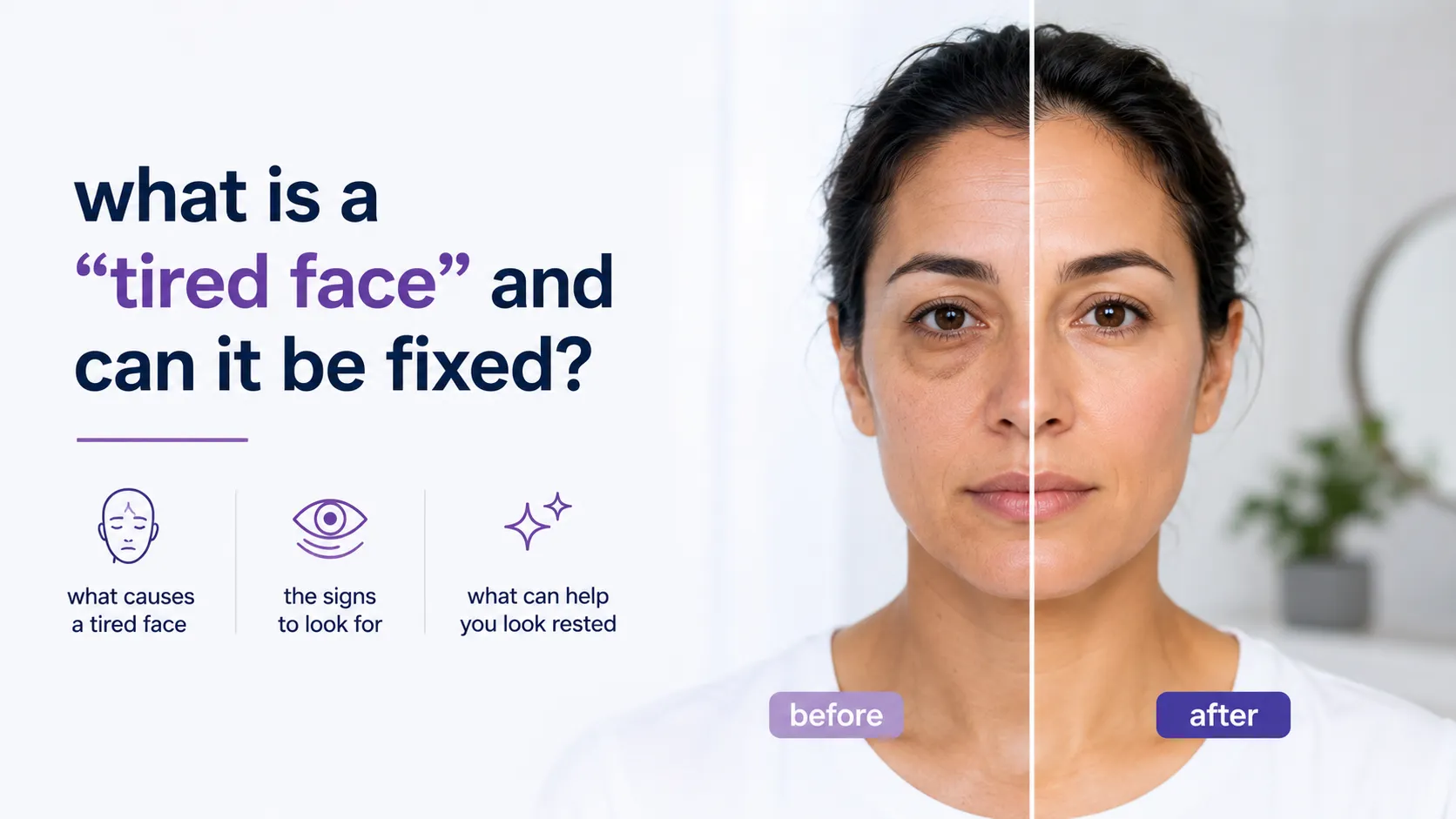
Tired face is more than tired skin. Here is what it really is, why surface fixes only go so far, and what an AI selfie scan can quietly reveal.
You catch your reflection in the bathroom mirror one morning, and the face looking back seems a little softer around the edges than usual. Your cheeks look puffier, your eyes heavier, and your skin a shade duller. The face looks tired even though you went to bed on time and slept the full night. The reflection does not quite match the rest you thought you had.
This is the experience people now call tired face. Once you notice it, you start seeing tired faces everywhere. It shows up in old photos from days you remember feeling fine, and in coworkers who say they slept well. It is a small, persistent thing that is easy to feel but hard to name.
This post explains what tired face is, why quick fixes only help a little, and what deeper cause often sits underneath it.
What does facial tiredness look like?
Tired face is a set of visible signs that can make a face look tired even when the person inside it has not yawned all morning. There is no medical label for it. It is more like a common look that millions of people know, but very few can describe well.
The pattern often includes soft puffiness around the eyes, darker shadows under them that can lookblue or brown depending on skin tone, dull skin across the cheeks and forehead, a jawline with lessshape, a slight downturn at the mouth, and eyelids that sit a little lower than they used to.
None of these signs means much on its own. The face reads as tired because of the mix, and because the look often hangs around even after a long weekend of catch-up sleep.
This is the most common question about tired face. The honest answer is that the number of hours you spend in bed is only part of the story. The quality of what happened during those hours matters just as much.
Two people can both sleep seven and a half hours. One wakes up rested. The other wakes up as if they barely slept. The difference is often breathing, oxygen, and what the nervous system was doing through the night. If the body spends the night fighting small disruptions, even ones the sleeper never remembers, it recovers far less than the clock suggests.
When the body does not fully recover overnight, the face often shows it first. The face has many blood vessels, lymph paths, and small muscles, so changes in sleep can show up there quickly.
They help, and they are worth doing, but they tend to help temporarily rather than completely. Most of us, when we notice a tired-looking face in the mirror, reach for something we can apply, drink, or sleep our way out of. A richer moisturizer, a cool compress, an early bedtime, an extra liter of water. These habits are good for many reasons, and they do produce real improvements.
After a deep night of rest, the puffiness softens. After a few days of drinking more water, the skin looks a little brighter. The under-eye creams calm the area for a few hours. The thing many people quietly notice, though, is that these improvements often fade. The face looks better for a morning, or a week, and then drifts back to the version that started the search in the first place.
This is not because the products are not working. It is because the visible signs of tired face are often the surface expression of something happening deeper down, in the way the body recovers, or fails to fully recover, during sleep.
The biggest driver of ongoing facial tiredness is often not how long a person lies in bed, but howwell they sleep during that time. Research suggests that obstructive sleep apnea, the most common kind of sleep breathing problem, affects between 10% and 30% of adults depending on the group studied, and about 80% of moderate-to-severe cases remain undiagnosed.
People with sleep apnea often go to bed on time, sleep what looks like a full night, and wake up exhausted. Their bodies may spend the night handling dozens or hundreds of brief wake-ups to keep the airway open. That repeated strain takes a subtle but cumulative toll on the heart, the lymphatic system, and the smaller blood-flow paths near the face.
That toll often shows up the next morning around the eyes, cheeks, and jaw. The body is trying to recover, and most mornings it nearly manages. But the recovery never quite finishes because the underlying disruption keeps coming back each night.
It can be. Noticing the pattern is often the first step toward finding out.
There are a few quiet signals that suggest tired face may reflect something structural rather than something surface-level. None of them is a diagnosis on its own, and noticing them is not a reason to panic. Still, together they often paint a picture worth paying attention to.
The first signal is that the tiredness shows up even after what should have been a good night of sleep.
The second is that mornings bring a dry mouth, a mild headache, or a sore jaw that fades by mid-morning but returns the next day.
The third is that the usual cosmetic fixes, the ones that once worked, have started to do less.
The fourth is steady daytime fatigue or brain fog that has become so familiar it no longer feels like a symptom.
The fifth is a family history of snoring, especially among male relatives, even if you do not snore loudly enough to wake anyone else.
If three or more of these sound familiar, it is worth looking at what your sleep is doing each night rather than focusing only on sleep habits.
In recent years, AI face analysis has become good enough to spot facial and body patterns tied tohigher sleep apnea risk from a simple selfie. The Soliish AI selfie scan for obstructive sleep apnea looks at features like jawline shape, midface ratio, neck profile, and other face-shape clues tied to airway risk. It then gives a structured risk score that helps a person decide what to do next.
The scan takes about a minute on any smartphone, needs no app, and is meant to surface a signal you can choose how to use. It is important to be clear that this is a screening tool, not a diagnosis. A risk score is the start of a conversation, not the end of one.
For people who screen at higher risk, the Soliish path connects them to a licensed sleep telehealth provider for a proper consultation. If a diagnosis follows, treatment can begin from there. For people who screen at lower risk, the scan may offer reassurance, which is useful too.
 Schedule a demo now
When the underlying cause of tired face is sleep-related and is eventually identified and addressed, people often describe their face looking measurably different within weeks. The body is finally allowed to recover fully during the night instead of working through it, and the surface signs that have been showing up every morning gradually soften.
The under-eye shadowing tends to lift. The puffiness eases. The skin tone tends to warm back up. The jaw and mouth often settle into a more relaxed, rested appearance. None of this happens overnight, and the timeline varies from person to person, but the change is often noticeable enough that other people start mentioning it before the person themselves realises something has shifted.
This is the version of fixing tired face that lasts, because the cause has been addressed rather than masked. It is also the version that brings benefits well beyond appearance, because the same recovery that softens the face also supports the heart, the brain, the metabolism, and the energy levels that the body has been working overtime to compensate for.
If your face has looked tired for a while, and you have a quiet sense that something underneath might be part of the picture, a 60-second Soliish AI selfie scan may be a simple first step toward learning more.