Sleep apnea screening that works in real dental workflows
Why dental sleep programs struggle to scale
This is what teams experience day to day and exactly why good programs stall
Referrals disappear.
No feedback. No case flow.

Not enough time to educate and screen patients for sleep apnea

Can't treat without confirmed diagnosis and Rx for therapy

Inconsistent case flow can't scale without patient engagement and seamless provider handoffs
.webp)
No devices.
No questionnaires.

Facial structure predicts sleep apnea risk 91% of the time
From screening to therapy ready patients

With a national network of diagnostic testing and licensed sleep specialists
Whether you're launching a new dental sleep program or optimizing an existing one, we keep the workflow simple so your team can focus on patients, not process.
.svg)
.svg)
.svg)
.svg)
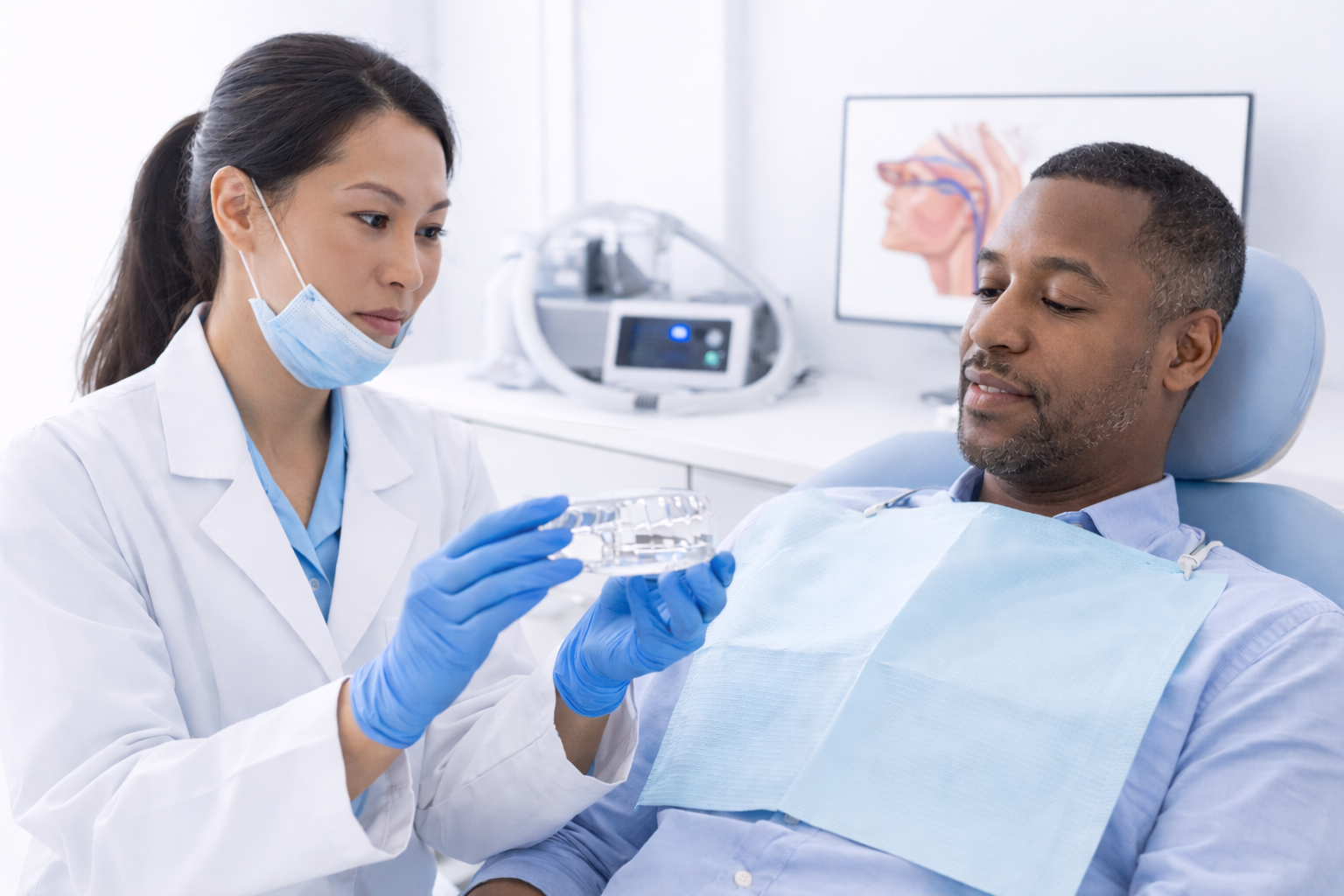


Dentists are uniquely positioned to identify OSA risk. You see patients far more regularly than their primary care physicians - often twice a year for preventive care and more often during restorative treatment. During every visit, you examine the oral and craniofacial anatomy most directly linked to airway risk: jaw structure, tongue size and position, palate shape, dental wear (bruxism), and TMJ patterns. The American Dental Association established in 2017 that all dentists should screen patients for sleep apnea.
Key indicators include: scalloped tongue edges (tongue scalloping), a high and narrow palate, macroglossia (enlarged tongue), restricted airway visibility (Mallampati classification), evidence of bruxism or tooth wear, TMJ discomfort, retrognathia (recessed jaw), and patients reporting frequent morning headaches or dry mouth. Any combination of these warrants a structured screening conversation.
No - screening is categorically different from diagnosing. Dentists do not diagnose OSA; that remains the responsibility of a licensed medical provider following a sleep study. Your role is to identify patients at risk and refer them for appropriate medical evaluation. This is explicitly supported by the American Dental Association, the American Academy of Dental Sleep Medicine (AADSM), and current dental sleep medicine standards published in 2025.
Soliish integrates into the chair-side visit without changing your clinical scope or adding meaningful time. A patient completes the face scan in under 60 seconds - during check-in, intake, or while waiting. The AI generates an immediate risk score that the dentist or hygienist can review, flag, and use as the basis for a brief conversation. For at-risk patients, the platform guides next steps: referral to a sleep physician, home sleep test, or telehealth consult.
Soliish is specifically designed to reduce administrative workload, not add to it. Practices using Soliish have reported up to a 60% reduction in manual administrative tasks across the patient screening and onboarding process. The platform automates risk scoring, documentation, and referral routing - your team doesn't need to manually track or coordinate screening follow-ups.
Best practice (per AADSM 2025 standards) is to refer patients to a licensed medical provider for diagnostic evaluation - either via a home sleep apnea test (HSAT) ordered by the dentist or referred to a sleep physician. Soliish's platform facilitates this referral workflow, ensuring the patient's risk score and clinical context transfer appropriately to the receiving provider. The dentist's role is completed at referral; diagnosis and treatment planning belongs to the sleep medicine team.
No. As per current AADSM standards, a definitive diagnosis from a medical provider is required before initiating oral appliance therapy. The face scan and screening results are triage tools - they identify who needs the sleep study, not who should start treatment. Your practice's involvement in OAT begins after a medical diagnosis is established.
A mandibular advancement device, often called a MAD or oral appliance, is a custom-fitted device worn during sleep to treat obstructive sleep apnea and snoring. It looks similar to a sports mouthguard and works by holding the lower jaw in a slightly forward position throughout the night. This keeps the airway open by preventing the tongue and soft tissues at the back of the throat from collapsing inward. MADs are recognised as a first-line treatment for mild to moderate obstructive sleep apnea, and as an alternative for patients with severe OSA who cannot tolerate CPAP. They are prescribed by a sleep physician and fitted by a qualified dentist.
Soliish generates structured screening records that can be integrated into your practice management system or EHR. This supports consistent documentation of screening conversations, risk scores, and referral actions - important for both clinical continuity and liability purposes. The platform is designed with API-ready integration for existing healthcare workflows.
A MAD treats obstructive sleep apnea by gently moving the lower jaw forward to keep the airway open during sleep. This forward position pulls the tongue and surrounding tissues forward as well, preventing the collapse that causes apnea events and snoring. The result is fewer breathing interruptions, reduced snoring, better oxygen levels through the night, and more restorative sleep. Research suggests that MAD therapy can reduce the apnea-hypopnea index by 50 percent or more in many patients with mild to moderate OSA. A qualified dentist adjusts the device gradually over several weeks to balance therapeutic effect with comfort.
A MAD is suitable for adults with mild to moderate obstructive sleep apnea, patients with severe OSA who cannot tolerate CPAP, and people with significant snoring. Candidacy also depends on dental health, including enough healthy teeth to hold the device in place, adequate jaw mobility, and no severe TMJ problems. A diagnosis of OSA from a sleep physician is required before a MAD can be prescribed. Many people who could benefit from a MAD are never identified in the first place, which is where AI-based screening tools such as the Soliish AI selfie scan for obstructive sleep apnea are increasingly used to surface risk early. A qualified dentist then completes the dental assessment and fits the device.