The new AASM president has called for more collaborative sleep care across specialties. Here is why the vision matches where the field is already heading.
When Dr. Fariha Abbasi-Feinberg was installed as the new president of the American Academy of Sleep Medicine on June 15, 2026, her remarks did more than introduce her leadership.
They were a clear statement of where sleep medicine is heading, and what it will take to get there.
Three passages from her remarks are worth reading closely. They describe, from inside the profession, the same shift that has been quietly reshaping how sleep care actually reaches patients.
On the multidisciplinary nature of sleep medicine
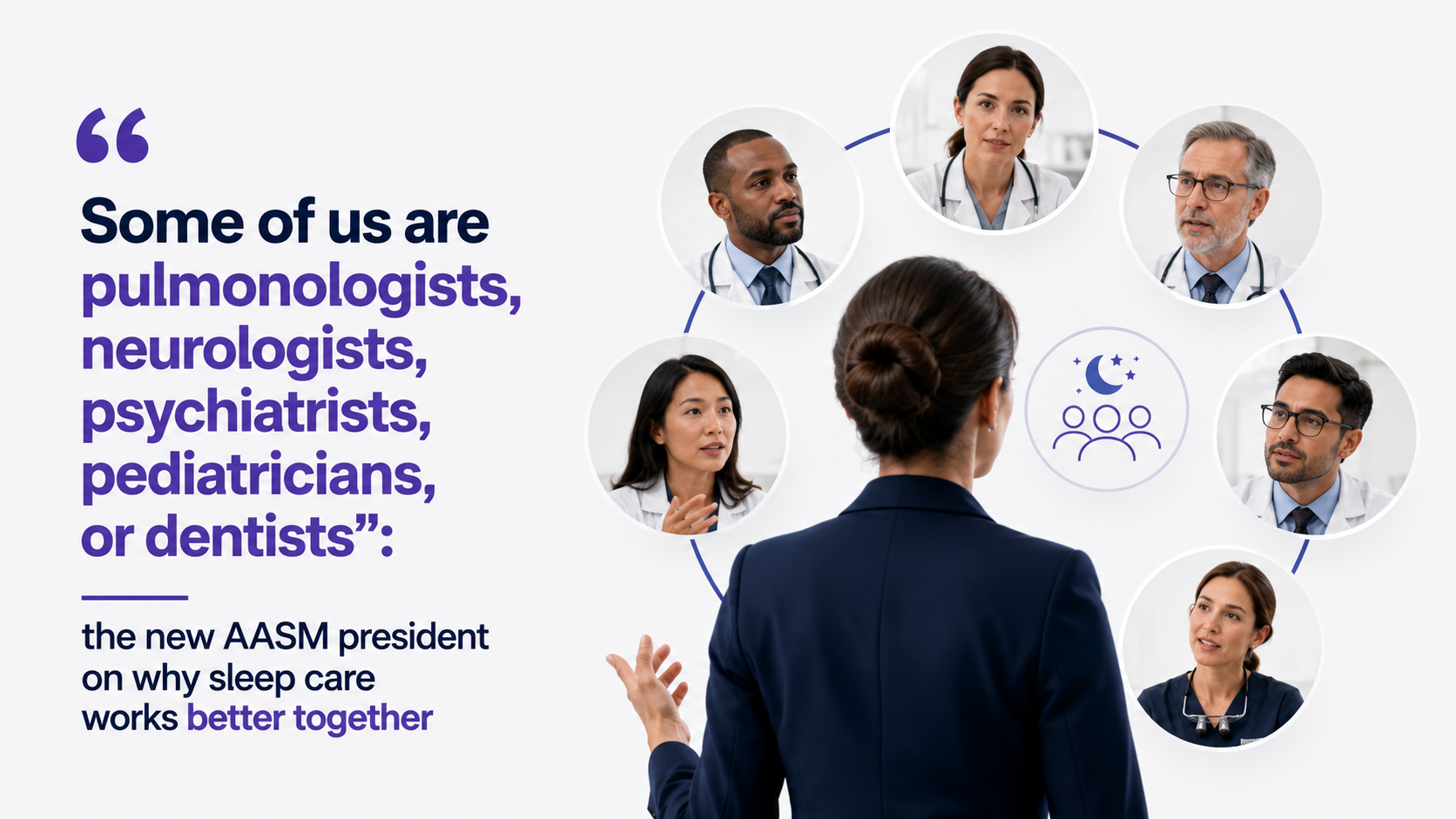
"I love that some of us are pulmonologists, neurologists, psychiatrists, pediatricians, or dentists. We are genuinely one of the most multidisciplinary specialties in all of medicine."¹
The incoming president of the leading sleep medicine society is publicly naming dentists as part of the field, alongside pulmonologists, neurologists, psychiatrists, and pediatricians.
That framing matters. It reflects a professional reality that has been developing for years but has not always been named this directly at the top.
Dentists have been recognized by the American Dental Association as the providers with the expertise to deliver oral appliance therapy for sleep-related breathing disorders.² Primary care physicians participate in early sleep health conversations. ENT specialists lead surgical and device-based interventions.
Each group has been part of the sleep medicine story for years. The language for describing that reality is catching up to the practice.
"Access to sleep care is a health equity issue. Too many patients never get a diagnosis, never get treatment, never even get the conversation. This has to change, and we are the ones to change it."¹
The access gap is real. A substantial share of adults with sleep-disordered breathing remain undiagnosed. Rural patients face documented barriers. Women are often underdiagnosed because their symptoms present differently.
The gap is not primarily a knowledge problem. It is an infrastructure problem.
Connecting patients to sleep care has historically depended on them reaching a sleep physician, which many never do for reasons that have nothing to do with the seriousness of their condition.
Naming access as a health equity issue changes the conversation about who is responsible for closing the gap.
"Integration is essential. Sleep medicine does not succeed in isolation. It flourishes when we are connected with primary care, cardiology, psychiatry, pediatrics, and dentistry. We have to make it easier for the rest of medicine to work with us. We need new models of providing sleep care."¹
This is a direct call for a different way of organizing sleep care.
Not more sleep specialists, or more sleep clinics, or more advocacy. A call for integration, new models, and making sleep medicine easier for other specialties to collaborate with.
The traditional model has been organized around the sleep physician as the central point of the pathway. That model has worked well for the patients who reach it. It has worked less well for the patients who do not, which is the majority.
Dr. Abbasi-Feinberg is describing a different architecture. One where patients can begin thinking about their sleep from any point in the healthcare system, including the dental office, the primary care visit, or the ENT exam.
One where sleep wellness conversations and connections to clinical resources happen through infrastructure that connects specialties, rather than requiring the patient to navigate between them.
This aligns closely with what technology and coordination infrastructure now make possible.
Soliish exists because the gap between patients whose sleep health warrants attention and patients who actually engage with sleep care is too wide to close through traditional referral pathways alone.
FaceX, the Soliish sleep wellness engagement experience, brings sleep health education into the settings where patients already are: dental practices, primary care offices, ENT clinics, digital health platforms.
FaceX combines a guided selfie, sleep wellness questionnaires, and user-provided information to help patients learn about factors related to their sleep and think through what to discuss with a qualified healthcare professional.
The clinical evaluation, when it is indicated, happens with the healthcare professional best positioned to provide it.
This is the kind of infrastructure Dr. Abbasi-Feinberg described. Not a replacement for sleep medicine. New models that make it easier for the rest of medicine to work with sleep medicine, and easier for patients to begin thinking about their sleep from where they already are.
The vision the AASM president articulated on June 15 is not a departure from the field. It is a mature acknowledgment of where the field has been heading, and a public commitment to leading it there.