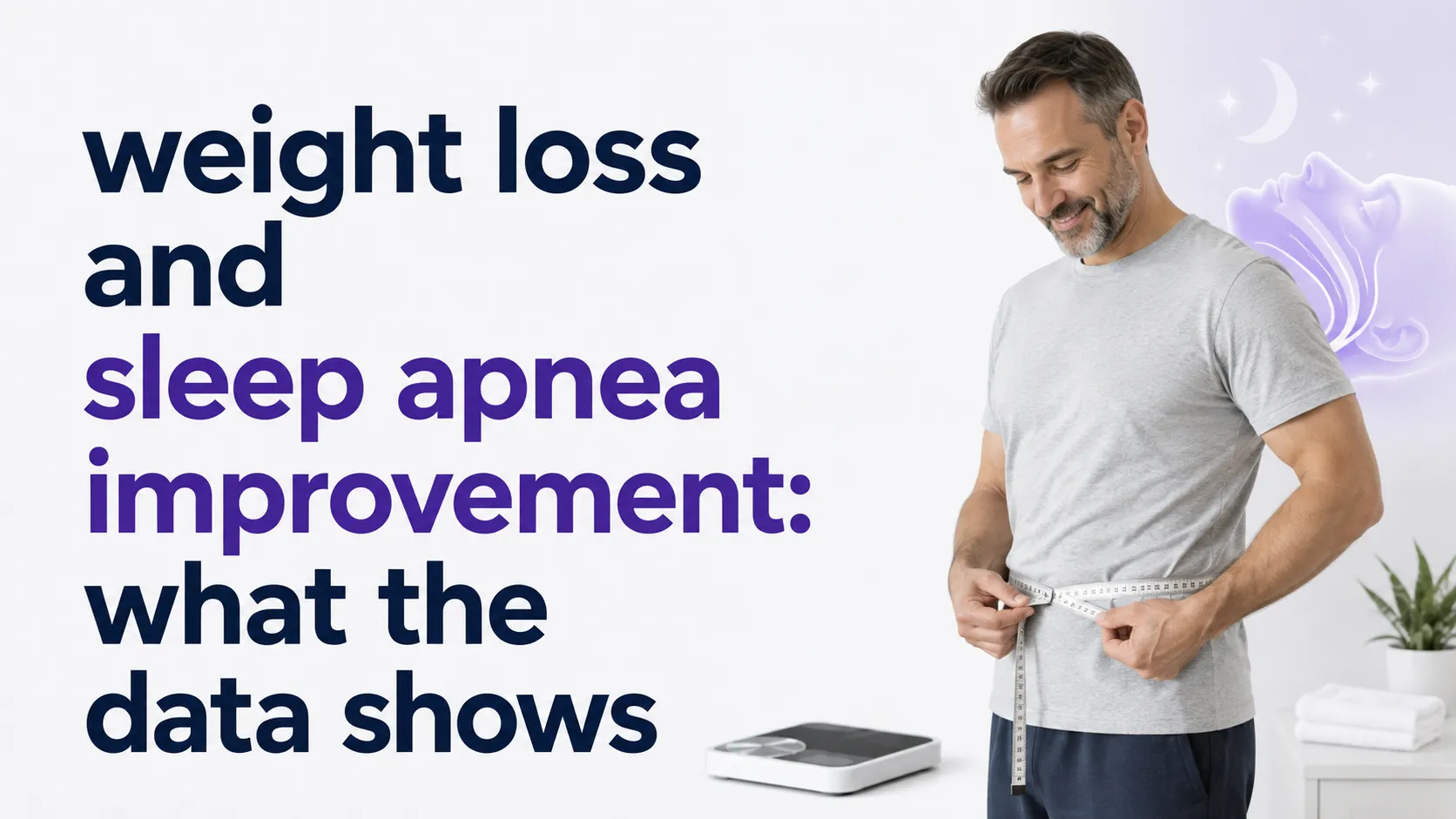
Can losing weight improve sleep apnea? Here is what the research actually shows about how weight, sleep apnea severity, and treatment outcomes connect.
"Lose weight." That is the advice, delivered in two words, usually right after "you have sleep apnea."
No number attached to it. No timeline. Nothing about what actually happens once you do it.
It sounds complete until you try to act on it. How much weight, exactly? Will it work for you specifically, or just for the average person in a study? And if some of it comes back next year, does the sleep apnea come back with it?
This post goes through what the research actually shows, in plain language, without the hand-waving.
Does losing weight actually improve sleep apnea?
Yes, and this part is not really in dispute. Weight loss can reduce how often breathing stops or partially stops during sleep, and that has been measured across multiple clinical studies.
The improvement shows up in a specific number: the apnea-hypopnea index, or AHI, which counts how many times per hour breathing stops or nearly stops. Weight loss tends to bring that number down.
Not everyone responds the same way, and the size of the improvement varies from person to person. But the direction is consistent enough that it is not just a feel-good talking point.
Less weight, in a lot of cases, genuinely means less severe sleep apnea.
The pattern is dose-dependent. More weight loss tends to bring more improvement, not a flat effect that kicks in at some magic number.
The Sleep AHEAD study, one of the larger trials on this question, found that people who lost more weight saw bigger drops in their AHI. The biggest gains showed up in those who lost around 10 kilograms (about 22 pounds) or more.
In that trial, the weight-loss group lost an average of 10.8 kilograms over a year and saw their AHI drop by 9.7 events per hour compared to the control group.
For someone with moderate sleep apnea, a drop like that can genuinely shift where they land on the severity scale. Small weight changes tend to produce small changes.
The mechanism is mostly anatomical, and it comes down to two areas: the neck and the belly.
Fat around the neck and throat can crowd the airway, narrowing the space air needs to move through while you sleep. When that tissue shrinks, the airway has more room, and it is less likely to collapse when the surrounding muscles relax overnight.
The belly matters for a different reason. Abdominal fat affects how the lungs and diaphragm move during sleep. Less of it tends to make breathing mechanics easier, which supports a more stable airway.
This is part of why weight loss helps even when nothing else about a person's risk profile changes. It is altering the physical conditions that make the airway vulnerable in the first place.
Not exactly. This is the part the "just lose weight" advice usually skips entirely.
Weight loss helps most people whose sleep apnea is weight-related, but not everyone's sleep apnea is caused by weight in the first place.
Plenty of people with sleep apnea are not overweight at all. Their risk comes from facial and airway anatomy instead, things like a recessed jaw, a narrow palate, or a tongue that sits high in the mouth. For that group, losing weight does not touch the actual structural cause.
Even among people whose sleep apnea is weight-related, the response varies more than most advice admits. Some see dramatic improvement. Others see something partial. A few see less change than the averages would suggest.
This is why sleep medicine does not treat sleep apnea as one condition with one fix. What is driving it matters, and the right approach depends on the answer.
This is the harder part of the story, and it is worth saying plainly.
Long-term follow-up shows that early improvement in sleep apnea can fade if the weight comes back. The relationship runs in both directions.
If weight loss helps by reducing tissue around the airway and easing breathing mechanics, weight regain can undo some of that. People who lose weight, see their AHI improve, and then regain the weight often see it climb back up too.
That does not make the weight loss pointless. It just means treating weight as a sleep apnea therapy takes the same ongoing commitment as any other lifestyle-based treatment.
Keeping the weight off is what keeps the benefit in place. For some people that is realistic. For others it is harder than the initial weight loss itself. Either way, the sleep apnea improvement is one of several reasons to maintain the habit, not a standalone finish line.
For people with severe obesity and sleep apnea, bariatric surgery is a fundamentally different kind of intervention.
Studies comparing surgical and lifestyle approaches have found that bariatric surgery tends to produce larger and more sustained weight loss than diet and exercise alone. The sleep apnea improvements tend to follow that same pattern.
It is the same dose-dependent relationship showing up again. More weight loss tends to mean more improvement, and surgery is a more powerful lever for people who qualify for it.
Bariatric surgery is not the right call for everyone, and the decision involves a lot more than sleep apnea alone. But for people already weighing it for other reasons, a meaningful improvement in sleep apnea is often a real additional benefit worth factoring in.
The research on weight loss and sleep apnea is genuinely encouraging. For a lot of people, losing weight produces a real, measurable improvement, with bigger losses generally producing bigger gains.
A few things are worth holding onto alongside that good news. Weight loss is not the only treatment for sleep apnea, and it does not help everyone equally, especially when the sleep apnea is driven mainly by airway anatomy rather than weight.
The improvement also depends on keeping the weight off, since early gains can fade if it comes back.
Working with a sleep doctor, a primary care physician, or a registered dietitian is the right way to build weight management into an actual treatment plan. The combination of medical guidance, sustainable habits, and other treatments where appropriate, including CPAP or oral appliance therapy, tends to produce the best outcomes.
If you have not been formally evaluated and suspect sleep apnea might be part of your story, figuring that out is the first step before any of this becomes actionable. The FaceX AI selfie experience by Soliish uses facial analysis and a short set of questions to help you learn about factors related to your sleep and think through what to discuss with a qualified healthcare professional.