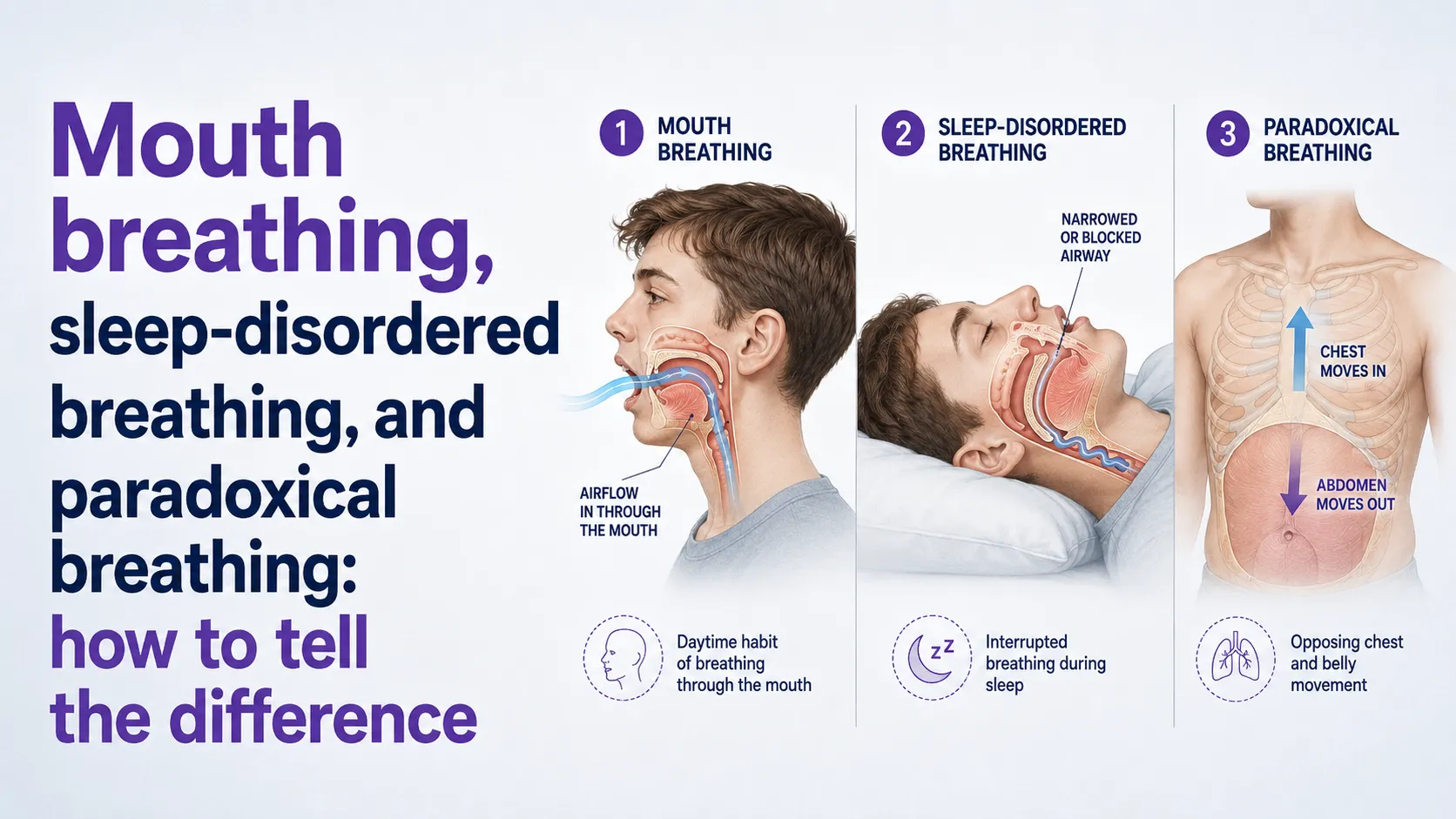
Three breathing terms explained: mouth breathing, sleep-disordered breathing, and paradoxical breathing. Here is what each one means and how to tell them apart.
Three breathing terms show up in sleep and airway conversations often enough that it is worth knowing what each one actually means. Mouth breathing is the most familiar. Sleep-disordered breathing sounds clinical but covers a broad range of conditions. Paradoxical breathing is the most technical and often the most concerning.
They are related, but they are not the same thing. Here is a clear breakdown of each, and how to tell which one might apply.
What is mouth breathing?
Mouth breathing is the pattern of breathing primarily through the mouth rather than the nose, either during the day, during sleep, or both.
It is usually a symptom rather than a habit. Most people who breathe through their mouth do so because nasal breathing is difficult or blocked. Common causes include nasal congestion, allergies, deviated septum, enlarged adenoids, and chronic sinusitis.
Occasional mouth breathing is normal, especially during exercise or when the nose is temporarily congested. The concern is chronic mouth breathing, particularly during sleep, which is associated with poor sleep quality, dry mouth, dental issues, and in children, changes to facial development.
Chronic mouth breathing is often connected to broader airway issues. If someone breathes through their mouth all night, their airway is usually telling them something worth investigating. The observable signs of long-term mouth breathing can include specific facial features that develop over time.
Sleep-disordered breathing (SDB) is a clinical umbrella term for any abnormal breathing pattern that occurs during sleep, ranging from mild to severe.
It includes several distinct conditions:
Sleep-disordered breathing is a big category. Different conditions within it require different diagnostic pathways and different treatments. What they share is that all of them disrupt normal breathing during sleep and, over time, affect health.
The most common form is OSA. Research suggests roughly one in five adults has some form of it, and the majority remain undiagnosed. The condition has documented associations with hypertension, cardiovascular disease, cognitive impairment, and daytime fatigue.
Paradoxical breathing is a specific abnormal breathing pattern where the chest and abdomen move in opposite directions from what is expected during breathing.
Normally, when you inhale, the chest expands outward and the abdomen also moves outward as the diaphragm drops. In paradoxical breathing, the chest moves inward (contracts) during inhalation while the abdomen still expands, or the two move in a desynchronized pattern.
The pattern is a sign of something else, not a condition on its own. Clinical research has documented paradoxical breathing in several contexts:
Paradoxical breathing observed in adults during sleep is a clinical finding worth investigating, particularly when it appears alongside other signs of sleep-disordered breathing. In infants under 2 to 3 years old, some chest contraction during inhalation is developmentally normal, but persistent paradoxical patterns still warrant medical evaluation.
The three terms describe different layers of the same broader landscape.
Mouth breathing is the surface behavior. It is what someone or their partner can observe: a person sleeping with their mouth open, dry mouth in the morning, snoring, drooling on the pillow.
Sleep-disordered breathing is the clinical category that captures why the breathing is abnormal. Mouth breathing during sleep is often one symptom of sleep-disordered breathing, but it is not the same thing. Someone can breathe through their mouth without having sleep apnea, and someone can have sleep-disordered breathing without obvious mouth breathing.
Paradoxical breathing is a specific pattern that may occur within sleep-disordered breathing, particularly during obstructive events. It is a finding on a sleep study rather than something most people can identify themselves. When paradoxical breathing shows up on a polysomnography report, it often points to airway obstruction, respiratory muscle issues, or another underlying condition.
Put simply: mouth breathing is what you see, sleep-disordered breathing is the diagnostic category, and paradoxical breathing is a specific mechanical sign that shows up in some cases.
If you have noticed you breathe through your mouth at night, wake up with a dry mouth, or your partner has commented on your open-mouth sleep, that is mouth breathing. The right next question is whether it is a symptom of something bigger.
If you have loud snoring, waking up gasping, morning headaches, daytime fatigue, or a partner has witnessed you stop breathing, that suggests sleep-disordered breathing worth evaluating clinically.
If a sleep study identifies paradoxical breathing patterns, that is a technical finding your sleep physician will interpret in the context of the rest of your results.
Most people cannot self-identify paradoxical breathing directly. It usually shows up during clinical evaluation. What most people can identify is whether their breathing during sleep seems off, whether their partner has noticed anything unusual, and whether they wake up feeling rested.
A self-check of common sleep apnea symptoms can help you decide whether a professional evaluation makes sense.
These three terms are often used interchangeably in casual conversation, but they describe different things. Understanding the distinctions helps when you are trying to figure out what to raise with a healthcare professional, or what to look for in a sleep study report.
Mouth breathing is the behavior. Sleep-disordered breathing is the clinical category. Paradoxical breathing is a specific mechanical pattern.
If any of these terms feel like they might apply to you, the right next step is a conversation with a sleep physician or an ENT specialist. The Soliish FaceX sleep wellness experience helps you learn about factors related to your sleep and think through what to discuss with a qualified healthcare professional.