Balloon sinuplasty comes up often in sleep apnea conversations. Here is why, what the research supports, and where the claims outrun the evidence.
Sinus problems and sleep problems often overlap in the same patient. If you have been dealing with both, or looking for help with your sleep and hearing about sinus procedures in the process, balloon sinuplasty is one of the interventions that comes up most often.
The connection makes intuitive sense. If your nose is blocked, sleep suffers. If your sinuses are inflamed, breathing at night is harder. So a procedure that opens sinus passages should help with both, at least in theory.
The reality is more specific than that. Balloon sinuplasty has a well-established role in ENT care, and for the right patient, it can meaningfully improve daily breathing, sleep comfort, and quality of life.
This post walks through what balloon sinuplasty is, why it comes up so often in sleep apnea conversations, what the evidence supports, and how to think about whether it might be relevant for you.
What is balloon sinuplasty?
Balloon sinuplasty is a minimally invasive procedure used to treat chronic sinus problems. It was developed as an alternative to more extensive sinus surgery, and it has grown into a widely used office-based intervention.
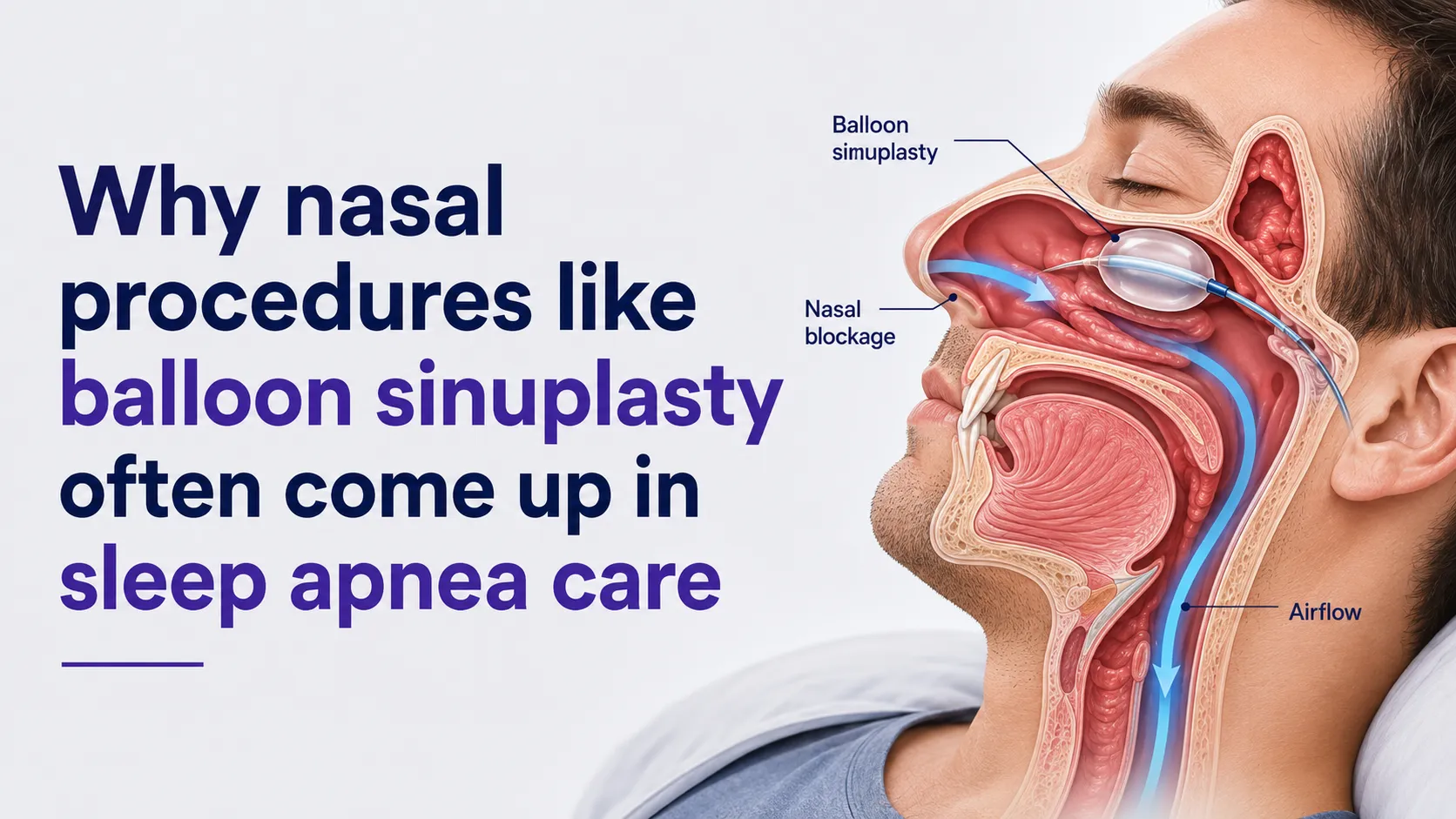
The procedure works through a straightforward mechanism:
The procedure is usually performed under local anesthesia in an ENT office, takes about an hour, and involves no cutting of bone or tissue. Most patients return to normal activity within a day or two.
Balloon sinuplasty is primarily used to treat chronic rhinosinusitis, which is a persistent inflammation of the sinuses that causes symptoms like facial pressure, congestion, drainage, and headaches. For that indication, the procedure has solid evidence behind it and is a well-established part of ENT practice.
The connection between balloon sinuplasty and sleep apnea is not that balloon sinuplasty directly treats sleep apnea. It is that chronic sinus problems and sleep problems often overlap in the same patient.
Several patient patterns explain why the conversation keeps circling back to sinus procedures:
Where balloon sinuplasty can genuinely help sleep apnea patients is in the supporting role. For patients with both chronic sinusitis and sleep apnea, treating the sinusitis can improve overall breathing comfort, reduce nasal congestion at night, and make CPAP therapy more tolerable. Research has shown that treatment of chronic sinusitis is associated with meaningful improvement in sleep quality for patients with these conditions.²
For patients whose snoring and sleep disruption is driven partly by sinus inflammation, resolving the sinus issue can produce subjective sleep improvement, even if the underlying apnea profile is unchanged. For patients diagnosed with mild sleep apnea who are struggling with nasal comfort during CPAP use, addressing chronic sinus problems may reduce the barriers to consistent therapy.
The patient who benefits most from balloon sinuplasty as part of a sleep apnea care plan usually has clear, documented chronic sinusitis alongside their sleep apnea, not just general nasal congestion.
If balloon sinuplasty comes up in a conversation about your sleep, a few questions worth asking:
The right answers depend on your specific clinical picture. Balloon sinuplasty for someone with clear chronic sinusitis, alongside a formal sleep apnea evaluation and appropriate primary therapy, is a defensible and often useful part of the care plan.
Working with both a sleep physician and an ENT specialist is the right way to sort this out. Each brings a different perspective, and each is looking at a different piece of the airway. Together, they can help you understand what is actually driving your symptoms and what interventions fit where.
Balloon sinuplasty is a good procedure for the right patient. It has a legitimate role in treating chronic sinusitis, and it can indirectly support sleep apnea care for patients with overlapping conditions. What it is not is a treatment for sleep apnea in the way that CPAP, oral appliance therapy, or hypoglossal nerve stimulation are treatments for sleep apnea.
The confusion is understandable. Sinus problems and sleep problems share so many symptoms, and improving one really can improve how the other feels. But feeling better and being treated are not the same thing, especially with a condition that does its damage silently over years.
If sinus issues have been part of your story and you are wondering how they fit with your sleep, a proper conversation with both a sleep physician and an ENT specialist is the best way to go.