"Sleep apnea face" is a popular term for a real pattern. Here is what research says about the facial features linked to sleep apnea risk.
You saw the phrase somewhere. Maybe on social media, maybe in a health article, maybe a friend mentioned it. Sleep apnea face.
The question that probably followed was whether it is a real thing, or another one of those internet health terms that sounds specific but does not mean much. And more personally, whether your own face might fit whatever "sleep apnea face" is supposed to be.
The answer is that it is a real pattern, backed by decades of clinical research. But it is not quite what internet articles often make it sound like. Here is what the research actually shows.
What is sleep apnea face?
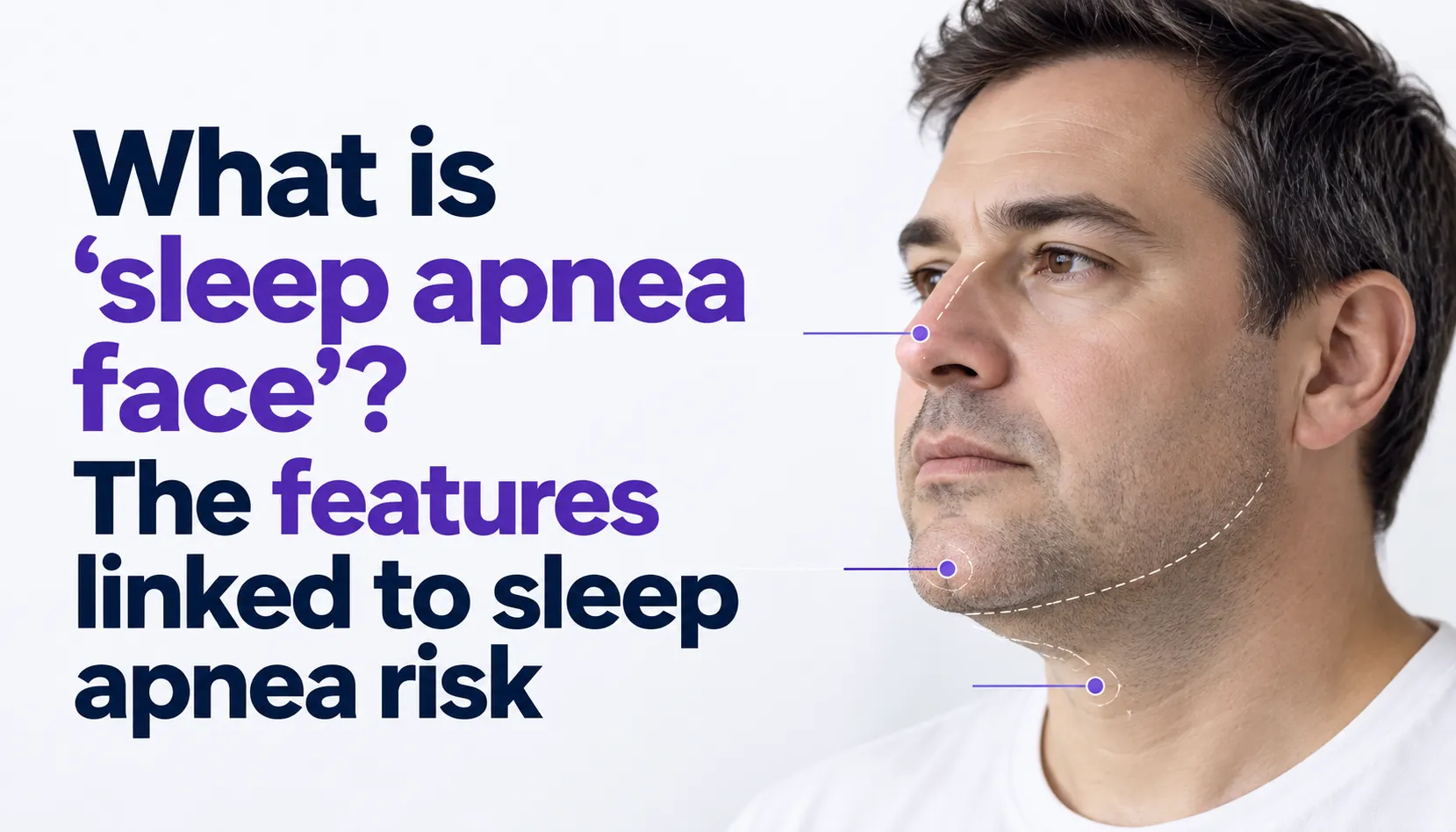
"Sleep apnea face" is a popular term for a set of facial features that research has linked to a higher risk of obstructive sleep apnea.
The term itself is informal. You will not find it in medical textbooks or clinical guidelines. But the features it refers to are well documented in the peer-reviewed literature, which describes them as craniofacial risk factors for obstructive sleep apnea.
A 2016 systematic review and meta-analysis of cephalometric studies confirmed that adults with obstructive sleep apnea have measurably different craniofacial anatomy compared to people without the condition.¹ The differences are consistent enough across studies that clinicians can often recognize the pattern visually.
So "sleep apnea face" is a real thing, in the sense that certain facial features do correlate with higher sleep apnea risk. It just is not a diagnosis, and having some of the features does not automatically mean you have sleep apnea.
The features most consistently identified in peer-reviewed research include several visible characteristics.
A recessed lower jaw. When the lower jaw sits further back than typical, the base of the tongue is positioned closer to the back of the throat. This narrows the airway during sleep. Research has shown that adults with sleep apnea have measurably shorter and more retruded mandibles compared to controls.¹
A longer face shape. Increased anterior lower facial height is one of the most consistent findings in adult sleep apnea patients.¹ The face appears taller and narrower rather than shorter and wider.
A narrow upper jaw and high-arched palate. A narrow maxilla reflects a narrower airway. This feature is common in adults who breathed through their mouths during childhood, which is when the palate normally widens.
A low-positioned hyoid bone. The hyoid is a small bone in the neck that anchors the tongue and airway muscles. When it sits lower than average, the airway is longer and more prone to collapse. This is one of the strongest cephalometric predictors of sleep apnea identified in the research.¹
A large tongue relative to the mouth. Increased tongue volume is a known risk factor for sleep apnea, particularly when combined with a smaller mandible.² The tongue simply has less room to sit without crowding the airway.
Increased neck circumference. More soft tissue around the airway increases the likelihood of collapse during muscle relaxation.
An open-lip posture. Chronic mouth breathing during sleep, and sometimes during the day, is both a symptom and a contributor to sleep apnea risk.
Not everyone with sleep apnea has all these features. And plenty of people have some of these features without ever developing sleep apnea. The pattern is a signal, not a diagnosis.
The connection is strong enough that peer-reviewed research consistently identifies these features as risk factors, but it is not deterministic.
A 2024 systematic review and meta-analysis published in the Journal of Sleep Research confirmed that specific craniofacial measurements are significantly associated with sleep apnea risk in adults.³ The features identified include reduced maxillary and mandibular lengths, retruded jaws, increased lower facial height, and a lower-positioned hyoid bone.
That said, anatomy alone does not determine who develops sleep apnea. Weight, age, muscle tone, hormonal factors, neurological factors, and lifestyle all contribute. Someone with the classic anatomical pattern may never develop sleep apnea if their other factors are favorable. Someone without the pattern can develop it because of weight, aging, or other reasons.
The practical takeaway is that the features raise anatomical risk. They do not guarantee sleep apnea, but they suggest an airway that is more vulnerable, especially if other factors accumulate over time.
No. This is one of the biggest misconceptions about sleep apnea and the face.
The classic sleep apnea profile in public awareness is a middle-aged, overweight man with a thick neck. That profile does exist, but it captures only a subset of the population with sleep apnea. Many people with the condition are neither overweight nor male.
Research has actually shown that craniofacial risk factors for sleep apnea are more commonly reported in non-obese patients than in obese patients.² When someone has sleep apnea without significant weight as a contributor, the anatomical features tend to matter more. This is why "sleep apnea face" features are especially important to recognize in slender, younger, or female patients whose condition is often missed by the classic profile.
If your face fits the pattern but you are not overweight, that does not mean you are safe from sleep apnea. It may mean the anatomical component of your risk is more relevant to your situation.
No. Facial features are one component of sleep apnea risk, but they cannot confirm or rule out the condition on their own.
Sleep apnea is diagnosed through sleep testing, which measures actual breathing patterns during sleep. Facial features are useful as a signal, especially when combined with symptoms, but they are not a substitute for evaluation.
The features are best understood as a starting point. If your face shows several of the recognized patterns, and you also have symptoms of sleep apnea (loud snoring, daytime fatigue, morning headaches, waking up gasping), the combination is worth taking seriously. That combination is a stronger signal than either the features or the symptoms alone.
The goal of understanding "sleep apnea face" is not to diagnose yourself. It is to know whether the possibility is worth exploring with a healthcare professional.
The answer depends on which features and at what age.
In children and teenagers, orthodontic and airway-focused interventions can meaningfully change how the face develops. Palatal expansion, mandibular advancement, myofunctional therapy, and treatment of underlying causes like enlarged adenoids can all improve facial development and airway function during the growth years.
In adults, the underlying skeletal features are largely set. Bone growth is complete, and the basic face shape does not change. What can still improve includes muscle tone, lip posture, soft tissue features, and airway function itself.
Adults with significant anatomical sleep apnea risk have several treatment options that address the airway without changing the face shape. Oral appliance therapy advances the jaw during sleep to open the airway. CPAP keeps the airway open with air pressure. In more severe cases, jaw surgery can reposition the mandible permanently.
The face may not change dramatically, but airway function often can.
If you look at your face and see several of the features linked to sleep apnea risk, the useful response is to think about the rest of the picture.
Do you have symptoms of sleep apnea? Loud snoring, waking up tired, morning headaches, daytime fatigue that does not lift with rest, a partner noticing you stop breathing at night?
If the features are there and the symptoms are there, the combination is worth investigating. A conversation with a sleep physician, or an ENT specialist, or a dentist trained in dental sleep medicine, is the practical next step. Sleep testing can determine whether sleep apnea is actually present and how severe.
If the features are there but no symptoms, the anatomy is a data point rather than an alarm. It is worth being aware of, especially as you age or if lifestyle factors change, but it does not necessarily require immediate action.
"Sleep apnea face" refers to a pattern of facial features linked to higher sleep apnea risk in peer-reviewed research. The features include a recessed lower jaw, a longer face shape, a narrow upper jaw, a low-positioned hyoid bone, a larger tongue, and an open-lip posture.
Having these features does not mean you have sleep apnea. But it does mean your anatomy makes you more vulnerable, and combined with symptoms, it is worth taking seriously.
If you recognize the pattern in yourself and want to think through whether sleep apnea might be part of what you are experiencing, connecting with the right healthcare professional is the practical next step. Soliish can help you explore that conversation.