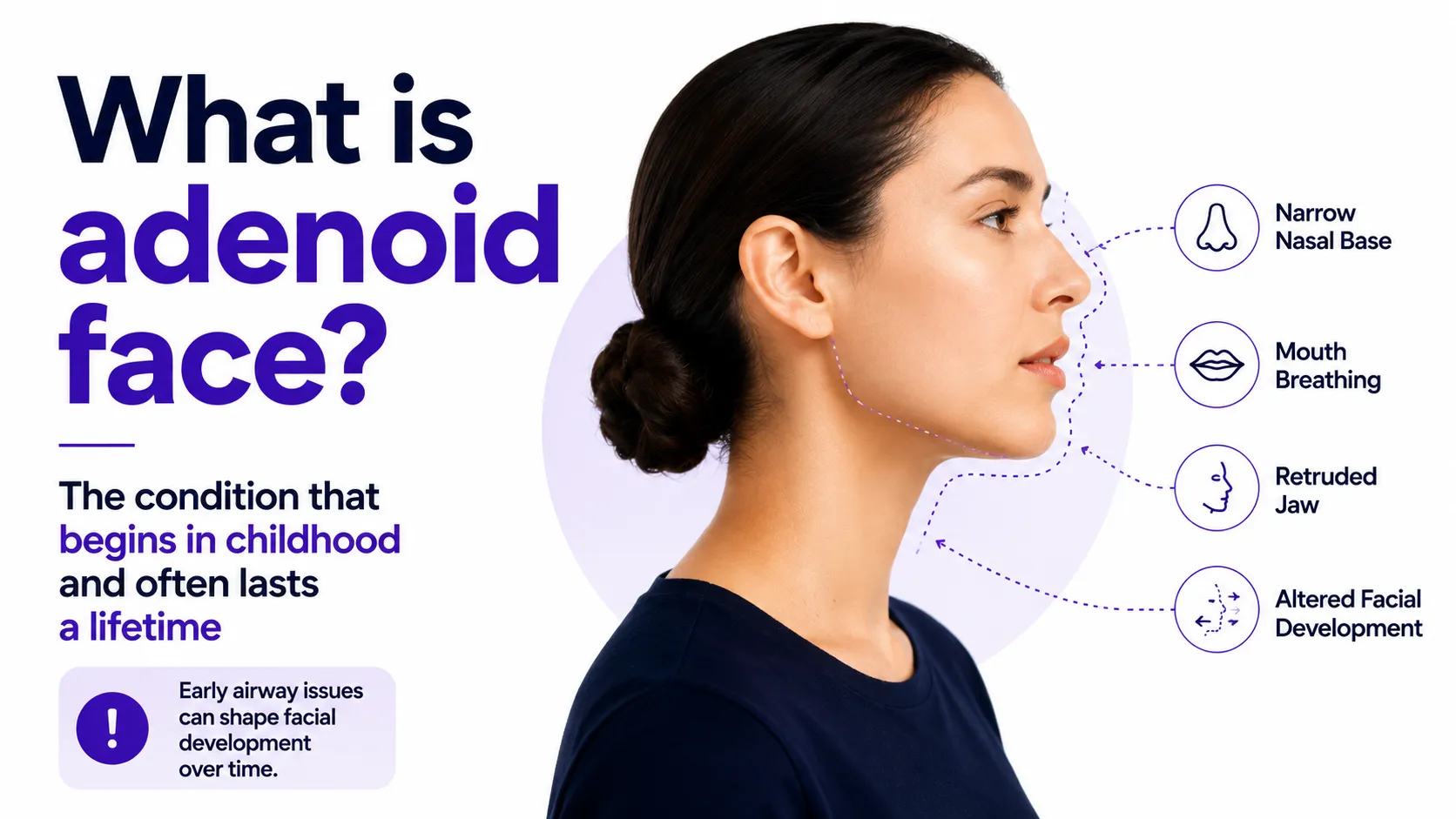
Adenoid face is a facial pattern that develops from chronic childhood mouth breathing and often lasts into adulthood. Here is what it means and why it happens.
Face shape gets blamed on genetics most of the time. But for some people, the shape of their face was influenced by something else entirely - how they breathed as a child.
If a child breathes through their mouth for years, their face develops differently. The pattern that results has a name in medical literature. It is called adenoid face.
Here is what it is, why it happens, and why the effects often last well into adulthood.
What is adenoid face?
Adenoid face is a specific facial pattern that develops in children who chronically breathe through their mouth, usually because enlarged adenoids block their nasal breathing.¹
The medical term for it is adenoid facies. Some clinicians also call it long face syndrome. Both terms describe the same thing.
The pattern has a set of recognizable features. A long, narrow face shape, a slightly open mouth even at rest, a receded lower jaw, a high-arched palate, crowded front teeth and sometimes dark under-eye circles.²
Not every child with adenoid face shows all these features. The extent depends on how early the mouth breathing started and how long it went on.
Adenoid face happens because chronic mouth breathing changes how the face grows.¹
When someone breathes through their nose, the tongue rests against the roof of the mouth. This gentle pressure shapes the upper jaw during growth, keeping it wide and well-formed.
Chronic mouth breathing pulls the tongue away from the palate. Without that steady pressure from below, the upper jaw does not develop as widely. The face compensates by growing more vertically instead of horizontally.³
At the same time, the child holds their lower jaw slightly open and back so air can flow through the mouth. Over years, this posture becomes the default position. The lower jaw ends up sitting further back than it otherwise would.
The result is the long, narrow face pattern with a receded chin that defines adenoid face.
Enlarged adenoids are the most common cause. Adenoids are patches of tissue at the back of the nose, above the tonsils. They fight infections in early childhood.
Sometimes they get too large and block nasal airflow. When that happens, the child cannot breathe through their nose comfortably. They breathe through their mouth instead, and the habit sticks.¹
Other causes of chronic nasal blockage can produce the same result - chronic allergies, nasal polyps, a deviated septum, chronic sinus infections etc. All of these can push a child toward mouth breathing that reshapes their face over time.⁴
The specific cause matters for treatment, but the underlying mechanism is the same. Blocked nasal breathing leads to mouth breathing, and mouth breathing changes how the face grows.
The changes usually begin in early childhood, often between ages 3 and 6.
This is when adenoids tend to be largest relative to the nasopharyngeal space. It is also when facial bones are growing fastest. The combination makes this age range particularly influential for facial development.
Research suggests that the duration of the airway obstruction matters more than how severe it is. A child with moderate obstruction that lasts for years may develop more pronounced adenoid face features than a child with severe obstruction that gets diagnosed and treated quickly.⁵
This is one reason why early identification matters. The longer the mouth breathing continues during the growth years, the more the face adapts.
The honest answer depends on age.
In young children, early treatment can meaningfully change the trajectory. Removing enlarged adenoids, treating allergies, or correcting nasal obstruction while the face is still growing gives the child's development a chance to normalize. Orthodontic interventions like palatal expansion can widen a narrow upper jaw during the growth years.¹
Myofunctional therapy, which retrains tongue posture and breathing patterns, is sometimes recommended alongside these treatments.
In older teenagers and adults, the skeletal changes are largely set. Bone growth is mostly complete, and the underlying face shape stays the same.
What can still improve in adults includes muscle tone, lip posture, and some soft tissue features. Adults who address their underlying mouth breathing (through treating nasal obstruction, using nasal breathing exercises, or treating sleep apnea if present) often see improvements in facial muscle tone, skin quality, and general appearance, even though the bone structure does not shift.
The features are not just cosmetic. They have real health implications.
The same anatomy that defines adenoid face (narrow upper jaw, receded lower jaw, high-arched palate) also narrows the airway. This makes the person more likely to develop sleep-disordered breathing later in life, including obstructive sleep apnea.
The connection runs in a cycle. Chronic childhood mouth breathing produces facial features. Those facial features narrow the airway. The narrowed airway makes sleep apnea more likely as an adult. And sleep apnea itself often involves mouth breathing at night, which reinforces the pattern.¹
This is why understanding adenoid face matters. It is not just about how someone looks. It is about airway function that has been shaped over years and continues to affect breathing during sleep decades later.
If a child is showing signs of chronic mouth breathing or the facial pattern is starting to appear, the first step is usually an ENT evaluation. An ENT specialist can assess the adenoids, tonsils, and nasal airway to identify what is driving the mouth breathing.
Depending on what they find, treatment might include adenoid removal, allergy treatment, or correction of nasal obstruction. A dentist familiar with orofacial development can also assess dental crowding, palate width, and jaw position.
For adults who suspect they carry adenoid face features from childhood, the useful next step is thinking about whether sleep apnea or upper airway resistance might also be part of the picture. The facial features that define adenoid face are the same features that predispose to airway issues in sleep.
Adenoid face is a real clinical pattern that develops when children breathe through their mouth chronically during their growth years. The features usually include a long narrow face, an open-lip posture, a receded lower jaw, and dental crowding.
The pattern begins in childhood, but the effects rarely stay there. The facial anatomy that develops from years of mouth breathing tends to persist into adulthood, and often continues to affect airway function during sleep.
Understanding what adenoid face is, and why it happens, is the first step toward addressing both the visible features and the underlying breathing patterns that shaped them.
If you carry features from years of childhood mouth breathing and wonder whether it might be affecting your sleep now, the FaceX AI selfie experience by Soliish uses facial analysis and a short set of questions to help you learn about factors related to your sleep and think through what to discuss with a qualified healthcare professional.