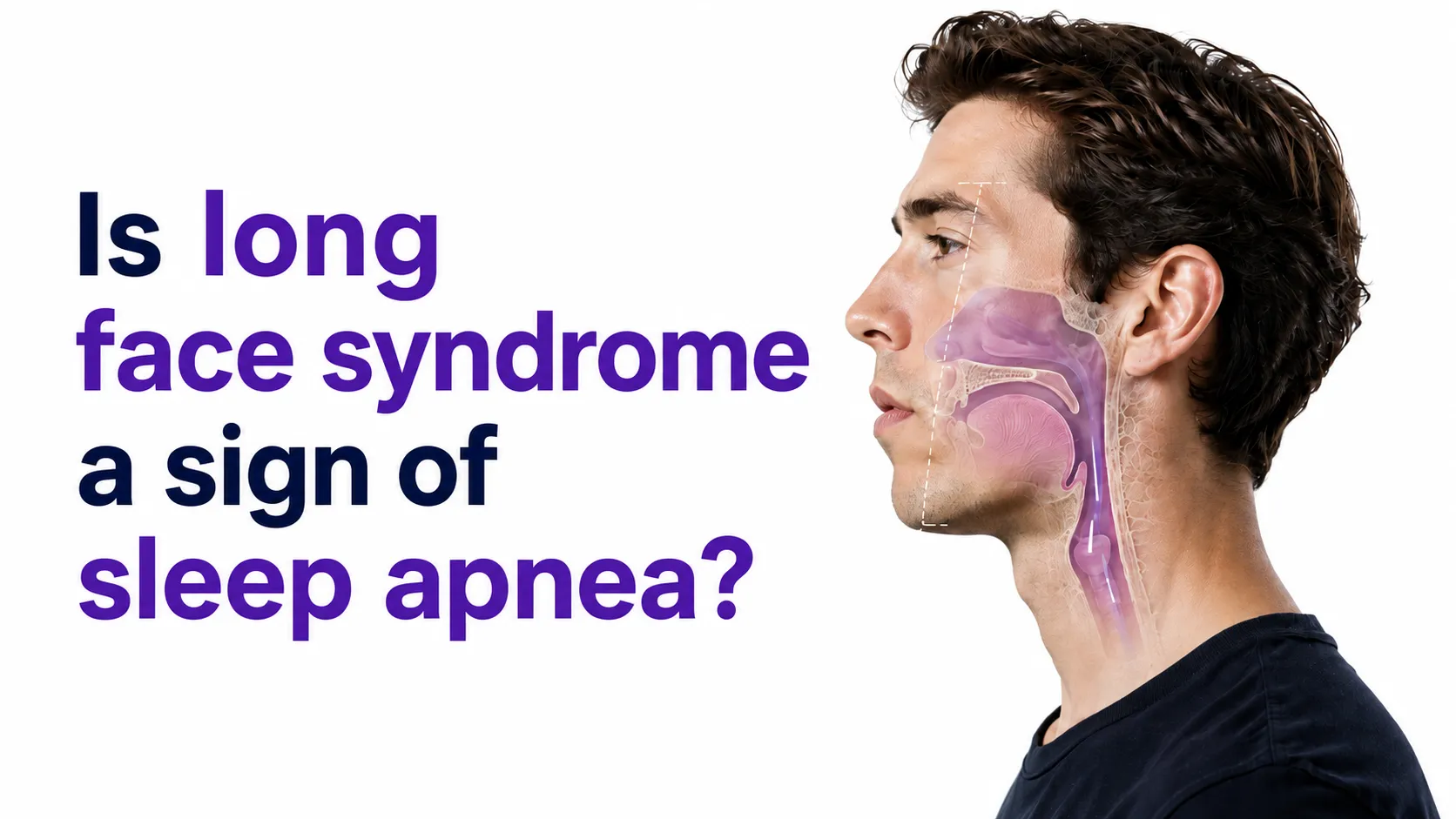
Long face syndrome is linked to a narrower airway and higher sleep apnea risk. Here is what the research shows about the connection.
Long face syndrome is a facial pattern which is longer, narrower face than average. A slightly open mouth at rest. A jaw that sits a little further back. It is a pattern with a real clinical name, and it is more common than most people realize.
If you have this pattern, or you have noticed it in someone you know, one question tends to come up. Does long face syndrome mean sleep apnea is likely too?
The short answer is that the two are connected in a meaningful way. Here is what the research actually shows.
What is long face syndrome?
Long face syndrome is a specific facial pattern where the face grows more vertically than horizontally, resulting in a longer and narrower shape than average.¹
Clinicians often call it the dolichofacial pattern or the high angle facial type. It is closely related to adenoid facies, and the two terms are sometimes used interchangeably.
The pattern usually includes several visible features.
It is important to note that not everyone with long face syndrome shows all these features. The extent varies from person to person.
Long face syndrome is linked to sleep apnea because the same anatomy that produces the long face pattern also narrows the upper airway.²
The connection is structural. When the upper jaw is narrow and the lower jaw sits farther back, there is less space at the back of the throat. The tongue sits closer to the back wall of the airway. The soft palate has less room.
During sleep, when the muscles that keep the airway open relax, this reduced space makes airway collapse more likely. That is the mechanism behind obstructive sleep apnea.
A 2024 systematic review and meta-analysis published in the Journal of Sleep Research confirmed that specific craniofacial measurements are significantly associated with sleep apnea risk in adults.³ The features it identified include reduced maxillary and mandibular lengths, retruded jaws, increased lower facial height, and a lower-positioned hyoid bone. These are exactly the features that define long face syndrome.
Having long face syndrome does not mean you definitely have sleep apnea. But it does mean your risk is higher than someone without the pattern.
Some people with the long face pattern have completely normal breathing during sleep. Others develop sleep apnea only later in life, when weight gain or aging adds to the anatomical baseline. And a smaller number develop sleep apnea at younger ages, even without obvious weight or lifestyle risk factors.
Research suggests that the more prominent the craniofacial features associated with long face syndrome, the higher the likelihood of sleep-disordered breathing.⁴ People who fit the pattern strongly are more likely to have sleep apnea than people who fit it partially.
The takeaway is that long face syndrome is a signal, not a diagnosis. It suggests the airway is anatomically more vulnerable, which is worth knowing about.
If you have long face syndrome, the sleep apnea signs worth paying attention to are the same signs anyone should watch for, but they carry more weight given the anatomical baseline.
Common signs include:
None of these signs alone confirm sleep apnea. But the more of them you notice in yourself, especially combined with the long face pattern, the more worth investigating the possibility becomes.
The answer depends on age.
In children and adolescents, orthodontic and surgical interventions can meaningfully change facial development while the bones are still growing. Palatal expansion, mandibular advancement, and myofunctional therapy are all approaches that can widen the airway and improve the facial trajectory.⁵
In adults, the skeletal features are largely set. Bone growth is mostly complete, and the underlying face shape stays the same.
What can still change in adults is airway function itself. Treating any underlying nasal obstruction, addressing sleep apnea if present, and improving overall breathing patterns can all improve how the airway performs, even if the facial anatomy does not change. In more severe cases, adult orthognathic surgery can adjust jaw position, but this is a significant intervention reserved for specific clinical situations.
If you have the long face pattern and any of the signs of sleep apnea, the useful next step is a conversation with a healthcare professional who can evaluate both.
Sleep physicians can order sleep testing to determine whether sleep apnea is present and how severe. ENT specialists can evaluate nasal obstruction and other upper airway issues. Dentists trained in dental sleep medicine can assess the dental and jaw components and, when appropriate, deliver treatments like oral appliance therapy.
The important point is that long face syndrome combined with sleep-disordered breathing symptoms is worth taking seriously. The anatomy behind the facial pattern is also the anatomy behind the airway risk. Treating one often helps the other.
Long face syndrome and sleep apnea share the same underlying anatomy. The features that make a face longer and narrower also make the airway smaller and more prone to collapse during sleep.
Having long face syndrome does not mean you have sleep apnea. But it does mean your risk is meaningfully higher, and it is worth knowing about, particularly if you have any of the common sleep apnea signs.
If you have noticed the pattern in yourself and want to think through whether sleep apnea might be part of what you are experiencing, connecting with the right healthcare professional is the practical next step. Soliish can help you explore that conversation.