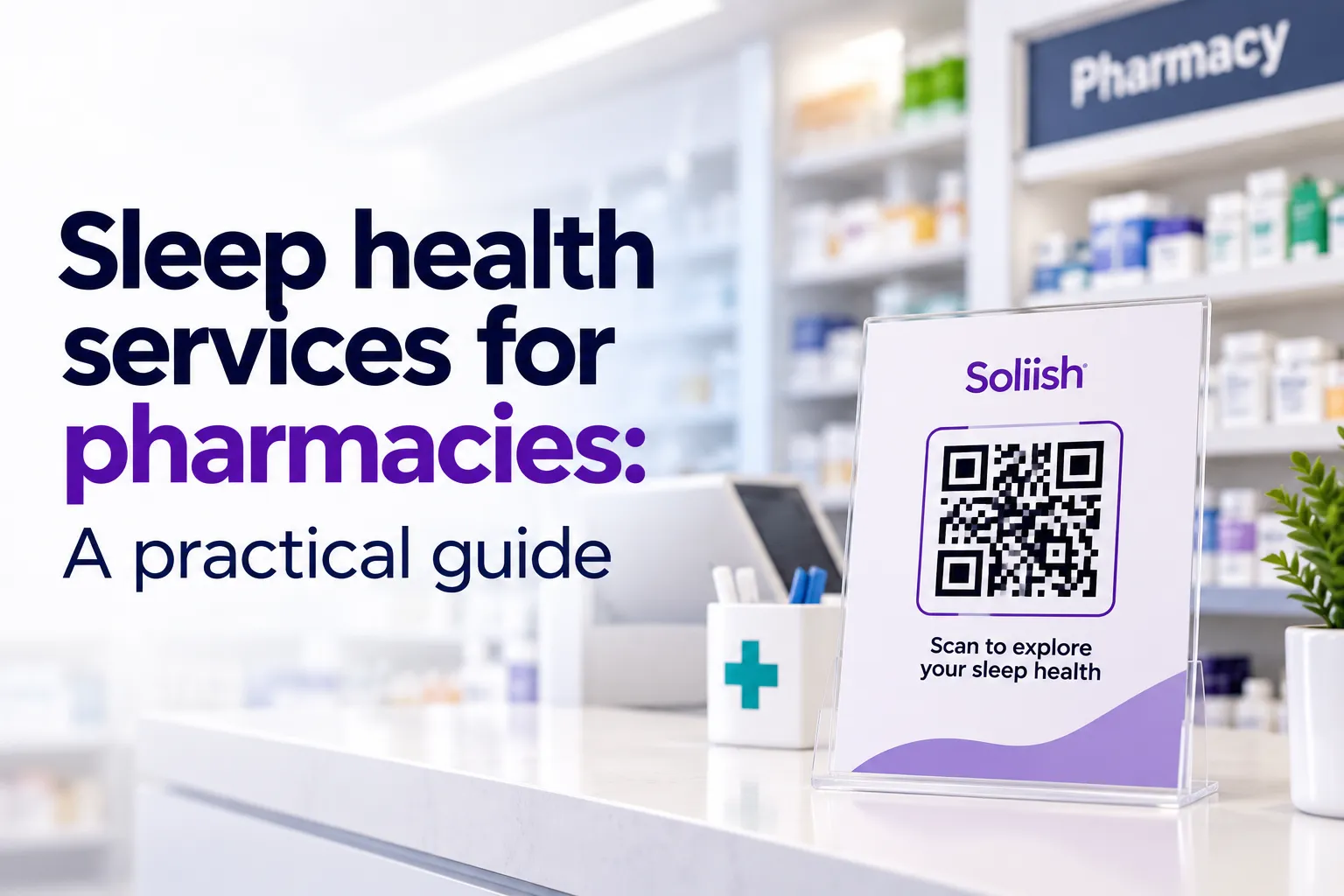
Explore how US pharmacies can offer sleep health services, engage customers, connect them with qualified providers, and build a practical program.
Community pharmacies regularly serve people managing blood pressure, diabetes, weight, medications, fatigue, and poor sleep. Those everyday touchpoints create a practical opening for sleep-health education and for helping people decide whether a conversation with a qualified healthcare provider may be worthwhile.
That does not mean turning the pharmacy into a sleep clinic. A well-designed pharmacy sleep-health program has a narrower role: make sleep health visible, give visitors an easy way to engage, and connect appropriate individuals with provider-led evaluation and testing.
This guide explains what sleep health services for pharmacies can include, what the evidence supports, where the clinical boundary sits, and how to build a service that works in a busy US pharmacy environment.
Why does sleep health belong in community pharmacy?
Community pharmacies regularly interact with people managing conditions associated with obstructive sleep apnea.
These include:
These associations do not mean that everyone with these conditions has sleep apnea. However, they can create opportunities for appropriate sleep-health conversations.
The pharmacy opportunity is also supported by a growing body of implementation research. A 2016 systematic review covering seven publications, 1,701 pharmacies, and 9,177 screened patients found that pharmacists could use structured approaches to identify people who might warrant further diagnostic evaluation. The authors also noted that the evidence base was limited and methodologically varied.1
In a 2014 cluster-randomized trial across 23 Australian community pharmacies, adding a portable nasal-flow measure to questionnaire-based assessment resulted in more confirmed OSA diagnoses than questionnaire assessment alone. Referral uptake remained a challenge, which reinforces an important lesson: identification is only useful when the next step is clear and easy to complete.2
More recently, a 2025 study in 22 Italian community pharmacies found that 38.5% of 301 participants screened as high risk using the Berlin Questionnaire. Higher body mass index and antihypertensive medication use were associated with high-risk results. That finding should not be treated as a US prevalence estimate, but it illustrates why the pharmacy setting continues to attract attention as an engagement and case-finding touchpoint.3
Moreover, pharmacies are accessible, familiar healthcare settings. They also interact with populations in which sleep-apnea risk can overlap with other health concerns. The American Heart Association has highlighted the high prevalence of obstructive sleep apnea among people with several cardiovascular conditions, including resistant or poorly controlled hypertension and recurrent atrial fibrillation.6
Pharmacies can participate in sleep health at several levels. Not every location needs to introduce a comprehensive program immediately.
1. Sleep health education and awareness
Education is one of the simplest ways to introduce sleep health into pharmacy services.
Pharmacies can use printed materials, counter displays, digital signage, and targeted campaigns to help customers understand common sleep concerns.
Topics may include snoring, daytime fatigue, poor sleep quality, and the relationship between sleep and chronic health conditions.
Educational materials can also explain when someone should consider speaking with a healthcare professional.
2. Sleep apnea risk questionnaires
Validated questionnaires can help identify individuals who may benefit from further evaluation.
Examples include the STOP-Bang questionnaire and the Berlin Questionnaire.
The Epworth Sleepiness Scale measures subjective daytime sleepiness. It can support a broader assessment but should not be treated as a stand-alone diagnostic test for obstructive sleep apnea.
Pharmacies considering these tools should review their intended use, staff training requirements, and applicable professional regulations.
Questionnaire results should guide appropriate next steps rather than be presented as a diagnosis.
3. Digital sleep health engagement
Digital tools offer another way for pharmacies to introduce sleep-health conversations.
For example, a customer could scan a QR code displayed near the prescription pickup counter and access a short sleep-health experience on their smartphone.
This approach allows customers to participate at their convenience without requiring pharmacy staff to administer every interaction.
Digital engagement can be offered through:
The experience should be easy to understand and clearly explain what customers can do next.
4. CPAP and sleep apnea therapy support
Some pharmacies may offer products or services related to prescribed sleep apnea therapy.
Depending on the pharmacy's capabilities, applicable requirements, and business model, these could include CPAP accessories, supplies, equipment coordination, or patient education.
Pharmacies offering these services should ensure that product provision, reimbursement, staff responsibilities, and any required supplier enrollment or accreditation are appropriately addressed.
5. Medication management and sleep health
Medication consultations can also create opportunities to discuss sleep.
Pharmacists may encounter customers reporting daytime fatigue, insomnia, or other sleep-related concerns.
Some medications can affect sleep quality, alertness, or breathing during sleep.
Pharmacists can review medication-related concerns within their professional scope and recommend clinical evaluation when appropriate.
6. Referral coordination
A sleep-health engagement program becomes more useful when customers understand their next steps.
Pharmacies can establish referral relationships with primary care clinicians, sleep medicine providers, and other qualified professionals.
For customers who may have elevated sleep apnea risk, this creates a clearer route toward clinical assessment.
The pharmacy introduces the conversation. Qualified healthcare professionals determine whether diagnostic evaluation and treatment are appropriate.
Soliish helps pharmacies introduce sleep-health engagement through a digital experience designed to fit into existing customer interactions.
At the center is FaceX, an AI-powered selfie experience that supports sleep-health awareness.
Customers can access FaceX through a QR code or digital link using their smartphone, without downloading a separate application.
The experience combines guided facial analysis with sleep-related questions and user-provided information.
Facial analysis helps identify structural characteristics associated with sleep apnea risk. The experience is intended to support awareness and informed conversations, not to diagnose or rule out obstructive sleep apnea.
1. A customer discovers FaceX
A pharmacy places a FaceX QR code near prescription pickup, in a consultation area, or within a digital campaign.
2. The customer completes the experience
Using their own smartphone, the customer follows the guided selfie experience and answers a short set of sleep-related questions.
3. The customer receives sleep-health insights
The experience provides information intended to help customers better understand potential sleep-health concerns and consider appropriate next steps.
4. Interested customers can explore clinical evaluation
Soliish supports connections to independent, qualified healthcare providers through coordinated referral pathways, where available.
Clinical providers remain responsible for determining whether diagnostic testing or treatment is appropriate.
For participating pharmacies, FaceX can provide a consistent way to introduce sleep-health conversations without requiring staff to conduct each interaction.
It can also complement existing wellness programs, chronic disease engagement, and appropriate sleep therapy support services.
For pharmacy groups, the same experience can be introduced across multiple locations while maintaining a consistent approach to customer engagement.
The commercial opportunity will depend on the pharmacy's service model, local requirements, partnerships, and the services it is authorized to provide.
Soliish helps pharmacies connect sleep-health awareness with appropriate next steps in care.
Sleep health services offer community pharmacies another way to support customers beyond routine prescription dispensing.
Research suggests that pharmacies can play a useful role in sleep-health awareness and identifying people who may benefit from further evaluation.
The most practical programs combine accessible education, simple customer engagement, and clear connections to qualified healthcare professionals.
For pharmacies, the opportunity is to introduce a relevant health service while exploring sustainable ways to support customers throughout their care journey.
Interested in bringing sleep-health engagement to your pharmacy?
Talk to the Soliish team about how FaceX can support a pharmacy sleep-health program.


No. Pharmacists can support education, approved risk-awareness workflows, medication-related conversations, and referral. Diagnosis requires appropriate evaluation and objective testing by qualified clinicians.
No. US guidance does not establish routine OSA screening for the general adult population. A program should define its intended audience and triggers, and it should distinguish general education from targeted risk-awareness activity.
No. On Soliish's pharmacy workflow, visitors can complete FaceX independently on their own phone or through a self-guided tablet or kiosk.
The visitor will be guided to an appropriate qualified provider for evaluation. The provider remains responsible for diagnosis, testing, prescriptions, and treatment decisions.
Potentially. The workflow may keep the pharmacy connected to appropriate products, prescriptions, supplies, adherence services, or care coordination, based on patient consent, privacy requirements, partner roles, and the agreed operating model.