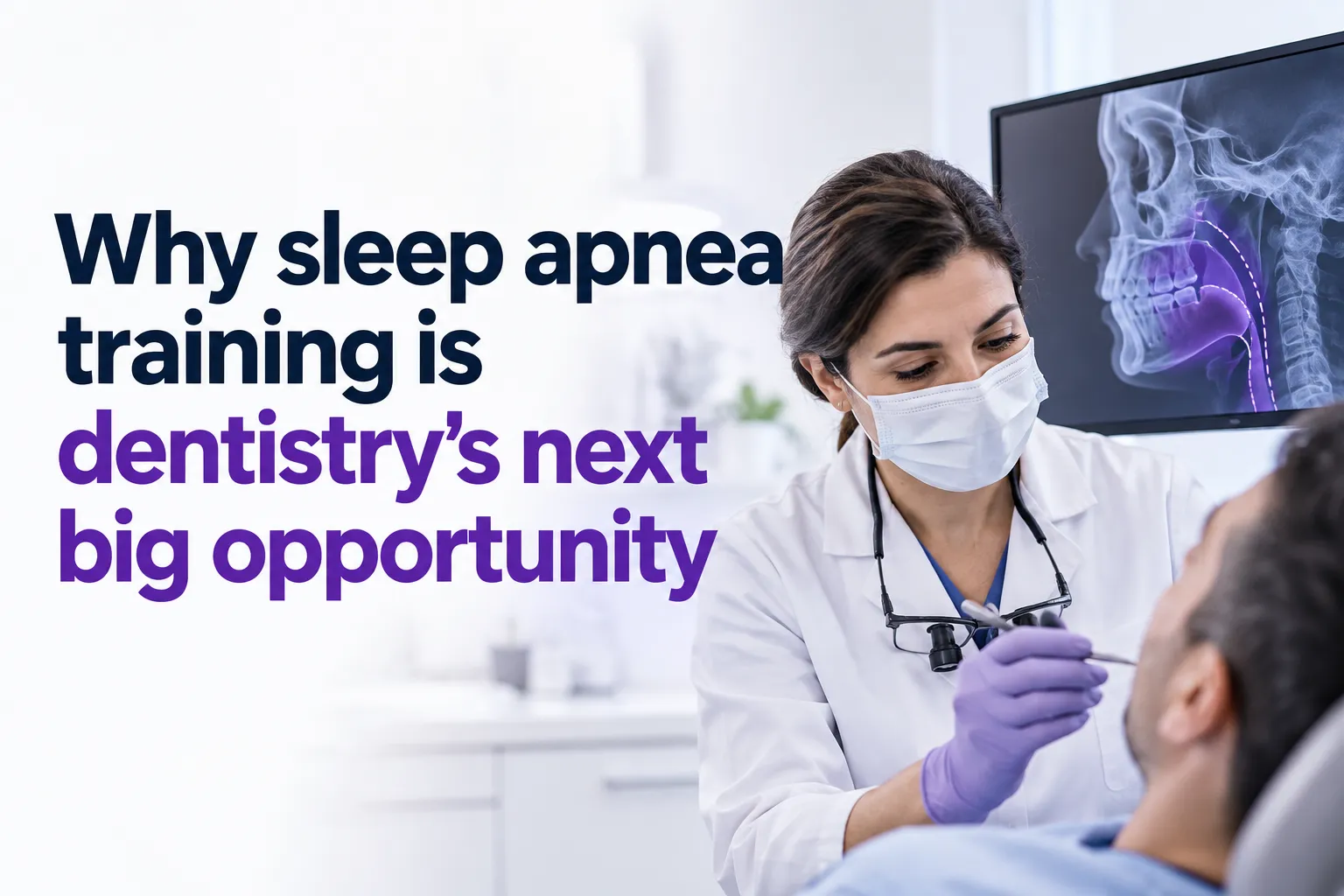
Sleep apnea training is one of the fastest-growing opportunities in dentistry. Here is why more dentists are adding it to their practice and what it involves.
You may have examined a patient this month with a narrow palate, an enlarged tongue, or a recessed mandible.
These findings do not establish that a patient has sleep apnea. But alongside their symptoms and medical history, they may warrant questions about sleep and referral for further evaluation.
Dental sleep medicine training helps dentists connect these observations to an appropriate next step, from recognizing potential risk to coordinating care with medical providers.
Why is sleep apnea training worth considering now?
Sleep apnea training is worth considering now because the gap between undiagnosed patients and available care is one of the largest in modern healthcare, and dentists are uniquely positioned to help close it.
An epidemiological review published in 2015 reported average OSA prevalence estimates of 22 percent in men and 17 percent in women, although estimates vary by population and diagnostic criteria.¹ Separately, an AASM-commissioned 2016 report estimated that approximately 80 percent of OSA cases in US adults were undiagnosed.²
In a 2008 study of 331 patients at two dental practices, questionnaire results classified 67 percent of men and 28 percent of women as having a high probability of at least mild OSA. These figures describe estimated risk in the study population, not confirmed diagnoses or prevalence across all dental patients.³
Some patients in your practice may have unrecognized OSA risk.
Professional guidance supports a role for dentists in recognizing OSA risk, referring patients for medical evaluation, and providing oral appliance therapy within coordinated care. The ADA describes this collaborative role, and the joint AASM/AADSM guideline provides recommendations for oral appliance treatment.¹˒⁴
Routine dental visits offer another opportunity to ask about sleep symptoms and recognize relevant oral or craniofacial features. A clear referral pathway can help patients move from that conversation to medical evaluation.
Some findings encountered during dental examinations may warrant a closer look at sleep history. They should be considered together, rather than treated as diagnostic signs on their own.
During the exam:
Tooth wear, dry mouth, and other oral findings may also prompt questions, but they have multiple possible causes and do not establish OSA.
In the patient history:
They already record much of this in routine dental assessments. The training gives them the framework to recognize the pattern as clinically significant rather than incidental.
For patients who attend regularly, dental visits provide repeated opportunities to discuss sleep health.
During an oral examination, dentists can assess features such as tongue size, tonsillar enlargement, palate shape, and mandibular position. These observations can complement a sleep history and structured risk assessment.¹
Dentists also have direct visual access to the upper airway. Every one of these carries information about airway risk that a primary care physician typically does not see.
Sleep apnea training for dentists can begin with continuing education on sleep-disordered breathing, risk assessment, and referral pathways. Dentists planning to provide oral appliance therapy need further education in patient selection, appliance management, side effects, and follow-up.
The AADSM currently specifies successful completion of Mastery Course I as the pathway to its Qualified Dentist designation. Completion of Mastery Courses I, II, and III provides eligibility to sit for the ABDSM certification examination.⁵
Shorter courses can build foundational knowledge, but they should not be presented as equivalent to the Qualified Dentist designation or board certification.
Adding sleep apnea services requires a defined workflow for risk assessment, referral, treatment, and follow-up.
Clinical integration. An OSA risk questionnaire such as STOP-Bang can support intake and assessment. The Epworth Sleepiness Scale assesses daytime sleepiness and may provide additional context. Neither tool diagnoses OSA, and Epworth alone should not determine whether referral is needed.⁶
Referral workflow. Patients with suspected OSA should be referred to an appropriate medical provider for diagnostic evaluation. The practice should define how referrals are made and followed up.⁷
Oral appliance therapy. Appropriately trained dentists can provide physician-prescribed oral appliance therapy for suitable patients. Care includes dental assessment, a custom titratable appliance, adjustment, monitoring for dental side effects, and coordination of follow-up sleep testing to confirm effectiveness.⁴
Financial considerations. Oral appliance therapy is typically billed through medical insurance rather than dental insurance, which involves a different billing workflow. Practices that adopt this successfully often work with a billing service or invest in staff training for medical billing.
Practice growth. Dental sleep medicine may create an additional service line and strengthen referral relationships. Its financial contribution depends on patient demand, reimbursement, training costs, staffing, and follow-through.
The coordinated care model between dentists and sleep physicians is exactly what the AADSM standards describe, and it is what makes dental sleep medicine actually work.
Dentists recognize potential risk, refer patients for medical evaluation, and provide oral appliance therapy when prescribed and clinically appropriate. Diagnosis remains the responsibility of an appropriately licensed medical provider.⁷
Clear communication between the dental and medical teams supports treatment selection, monitoring, and long-term follow-up.
For dentists getting into this space, building relationships with local sleep physicians is one of the most valuable investments you can make. A trusted referral partnership benefits both practices and the patient in the middle.
Soliish supports sleep-health engagement and connections to provider-led care within dental practice workflows.
An accessible starting point. FaceX combines an interactive selfie experience with short questions to help identify facial traits associated with elevated OSA risk and support earlier sleep-health conversations. It does not diagnose sleep apnea or replace a sleep study.
A shared reference point. The FaceX summary gives patients and dental teams a starting point for discussing sleep concerns and appropriate next steps. Treatment decisions remain with the clinical care team.
Support for referrals. Soliish connects appropriate patients with independent sleep telehealth providers for clinical evaluation. The pathway is designed to support follow-through from initial engagement to provider-led care.
Workflow integration. FaceX can be introduced through patient-facing links or QR codes, including before a dental visit. The workflow can be planned around the practice’s existing patient touchpoints.
A therapy-agnostic approach. Soliish supports connections to provider-led evaluation. Treatment recommendations are made by the clinical provider based on the patient’s needs.
Dental practices can contribute to earlier recognition of OSA risk and help patients reach appropriate medical evaluation.
For dentists interested in providing oral appliance therapy, established training pathways and professional guidance offer a framework for coordinated care.
The opportunity involves building the clinical knowledge, referral relationships, and follow-up processes needed to support patients well.