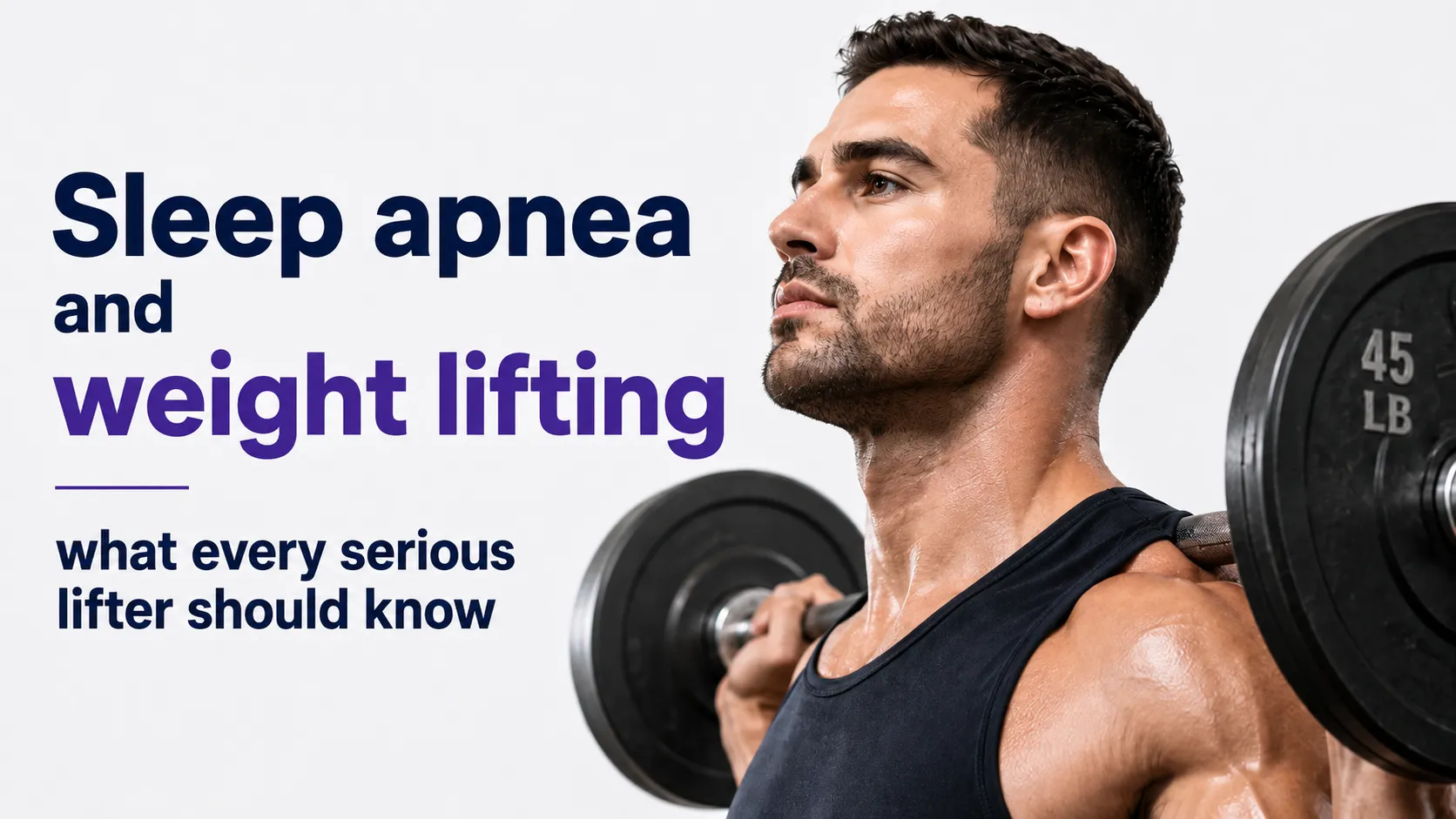
Weight lifting and sleep apnea have a two-way relationship most lifters never hear about. Here is what the research shows and why it matters for your training.
Most lifters have a routine they actually trust. The training is dialed in, the nutrition is tracked down to the gram, and recovery gets talked about constantly, even if it's not always taken as seriously as it should be.
And yet for a certain kind of lifter, something starts to quietly break down anyway. The lifts stall out for no obvious reason. Mornings feel heavier than they have any right to feel given how much sleep is supposedly happening. The bloodwork comes back a little off, in ways that don't line up with how hard this person is actually training.
This is the exact profile that keeps walking into sleep medicine clinics: a lean, disciplined lifter who gets told, almost as a surprise, that they have obstructive sleep apnea. And their first reaction is usually some version of "how is that even possible."
Wait, can lifters actually get sleep apnea?
Yes, and it's a lot more common than most training content admits. Sleep apnea in athletes isn't some rare edge case reserved for people who never see a gym. It's underdiagnosed precisely because it doesn't fit the picture people have in their heads.
A 2025 systematic review in the journal Life looked specifically at obstructive sleep apnea in athletes, and it found real prevalence in strength-based and collision sports, where a bigger neck tracked closely with higher risk.¹ Standard screening tools simply weren't built with this group in mind, so they miss it more often than you'd think.
Sleep apnea gets framed as a weight problem almost by default, and for a lot of patients, that's fair. But the American Dental Association's own clinical reference points to neck circumference as a risk factor in its own right, completely separate from body weight or BMI.² That distinction matters more than it sounds like it should.
Heavy training, especially the kind that builds up the traps, shoulders, and upper back, can genuinely grow the neck through muscle rather than fat. As that happens, the tissue around the airway gets denser, and the amount of room left for air to move through while you sleep can shrink, even in someone who's lean, strong, and doing everything "right."
That's really the whole reason the traditional sleep apnea picture misses lifters so often. They're not overweight by any normal measure. They train hard, eat clean, and still might be carrying this risk quietly, night after night, without a single obvious sign during the day.
Once sleep apnea shows up, it doesn't politely stay in its lane. It bleeds into basically everything else going on in your body.
That same 2025 Life review connected OSA in athletes to worse sleep quality, hormonal disruption, daytime sleepiness, and slower reaction times, and the researchers noted these things tend to stack, hurting recovery, raising injury risk, and dragging down performance overall.¹ Less time in deep sleep means less of the growth hormone release that normally happens there, which shrinks the anabolic window your body needs to actually repair and grow from training, no matter how well the program itself is written.
This is usually the part that gets a lifter's attention, because it goes straight to the hormone most people care about most.
A 2022 meta-analysis in Andrology, pulling from 18 studies and over 1,800 men, found a clear inverse relationship between OSA and testosterone, one that held up even after accounting for age and BMI.³ A 2021 study in Frontiers in Endocrinology found testosterone dropping as OSA severity climbed in a group of severely obese men,⁴ and a separate 2017 study in the Journal of Clinical Sleep Medicine found essentially the same pattern in men who weren't obese at all. Lower oxygen levels during sleep tracked with lower testosterone, regardless of body weight.⁵
None of this proves that treating sleep apnea automatically fixes low testosterone on its own, and it's worth being honest about that. But if your testosterone is lower than it should be given how you train and eat, sleep apnea is a real question worth asking, not a footnote.
Lifters live and die by recovery. The training is just the stimulus. The actual adaptation happens later, mostly while you're asleep.
A lifter dealing with untreated sleep apnea is trying to recover from increasingly demanding training on top of increasingly broken sleep, and that combination tends to start quiet before it turns into a real plateau. More volume won't fix it. More "recovery days" won't fully fix it either, if the sleep underneath it all is the actual problem. That same review pointed out that catching OSA earlier in athletes tends to improve both recovery and performance down the line.¹
If hormones and sleep quality are a topic you want to go deeper on, our piece on circadian rhythm and recovery digs into how the two connect.
Most standard screening tools, like STOP-BANG, were built around the general population, so they lean heavily on things like loud snoring, witnessed pauses in breathing, and daytime sleepiness. Those symptoms do show up in lifters, but they're easy to wave off as "that's just what training does to you."
For this group specifically, the more useful signal is anatomical rather than behavioral. The ADA's own reference lists neck circumference, retrognathia, a large tongue, and Mallampati score as observable risk factors, and notably, these can show up in people who don't fit the usual demographic at all.² A lifter with visible neck size built from years of training is a legitimate candidate for a real evaluation, whatever their body fat percentage says.
FaceX by Soliish is a sleep wellness engagement experience that looks at facial and airway related traits in about 60 seconds, which makes it a decent starting point for exactly this kind of case, where the standard weight-based checklist doesn't tell the whole story. It's not a diagnosis. It's a way to open up a conversation with a doctor that might otherwise never happen.
You can read more about how facial structure connects to airway anatomy in our post on facial structure and sleep health.
Sleep apnea doesn't care how disciplined your training is. It works on the same hormonal and recovery systems that every serious lifting program depends on, and it doesn't ask permission before it starts working against you.
If you've been sitting on a plateau, a hormonal profile that doesn't add up, or a level of fatigue that just doesn't match your effort in the gym, it's genuinely worth ruling this out. The evidence connecting sleep apnea to lifting outcomes is stronger than most training content gives it credit for, and it's the kind of thing that's easy to miss precisely because you feel like you're doing everything right.
If your training has started to feel like it's fighting something you can't quite name, a 60-second FaceX scan is a low-effort way to find out if this is part of the picture. Take the scan.