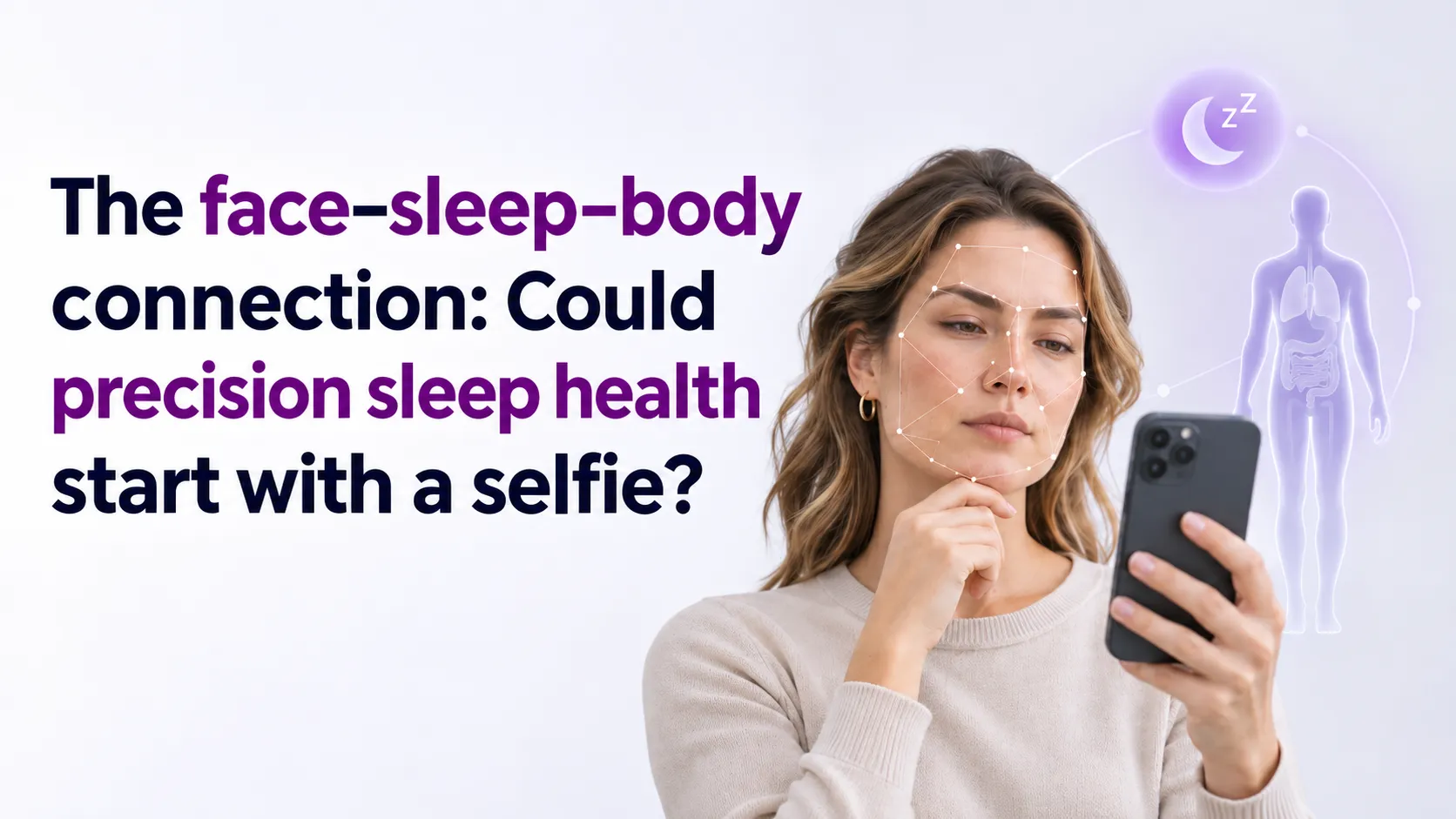
Soliish CEO Jatin Maniar on how facial structure shapes sleep, how sleep shapes the body, and why precision sleep health can start with a selfie.
Long before I founded Soliish, I spent my career on a single question: who are you?
In digital identity and facial biometrics, the face is a key. It unlocks a phone, confirms a payment, opens a border gate. Countless times a day, people hold up a camera, and the system answers that one question.
Over time, I started asking a different one. Not who is this person, but how is this person?
The face is not only a signature. It is structure. Bone, jaw, mouth, the space behind them. And that structure sits right at the entrance to something we spend a third of our lives doing: breathing while we sleep.
That shift is why Soliish exists. We have built an accessible, AI-powered precision sleep health platform, one that meets people where they already are: with a phone in their hand and a camera pointed at their face.
Our thesis at Soliish is simple. Sleep is behavior, anatomy, physiology, and biology, all at once. To understand it, you have to follow the connections. So in this piece, I want to walk through them one at a time. Face to sleep. Sleep to body. Face to body. And then all three together.
How facial structure affects sleep: the airway has an architecture
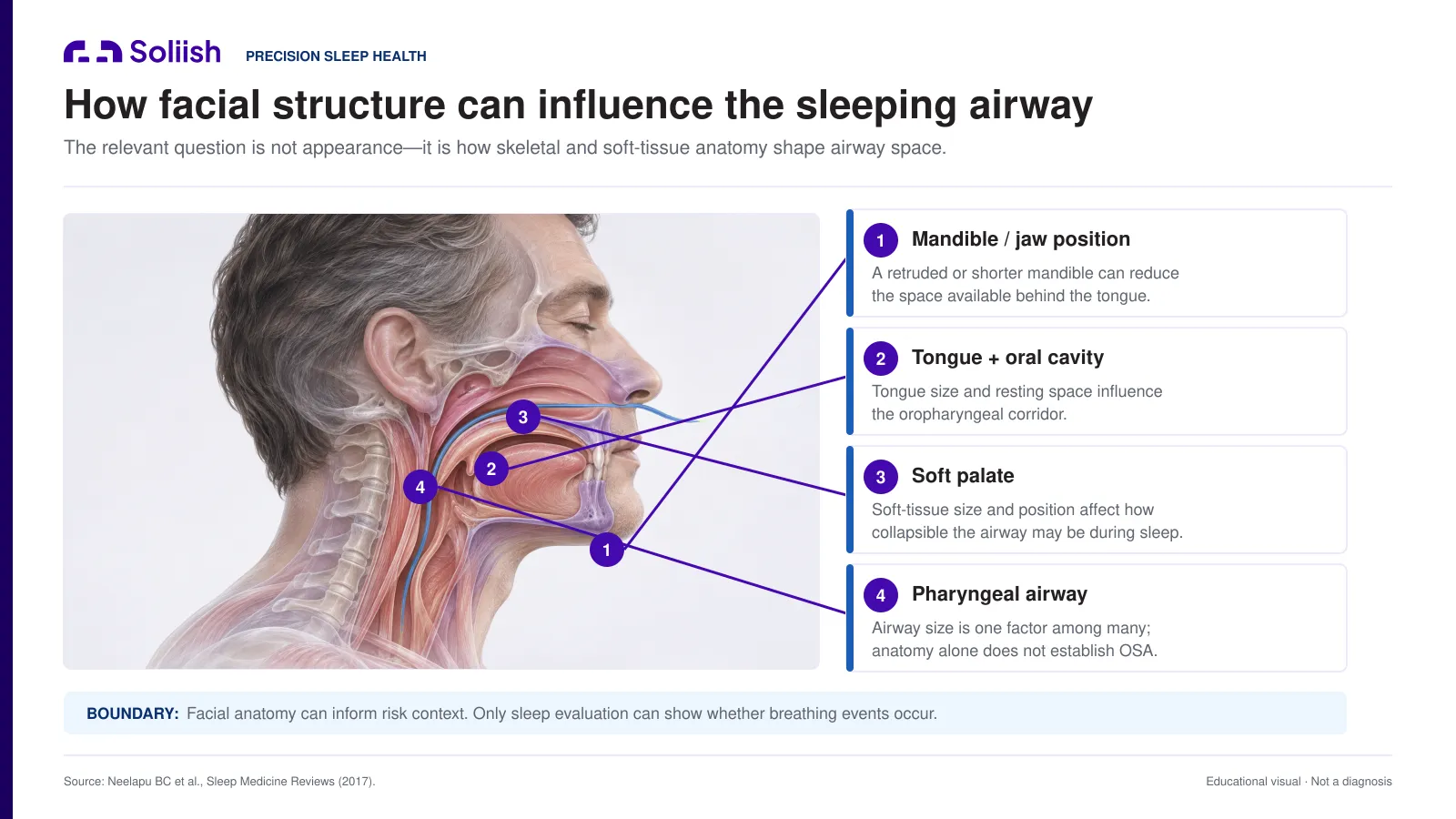
Every night, air travels a path shaped by the structures of the face and mouth. The position of the jaw, the shape of the midface, the room the tongue has to rest. These are not cosmetic details. They are the walls of the corridor we breathe through.
Researchers have studied craniofacial features for years in relation to sleep-disordered breathing.¹ A narrower space here, a set-back jaw there, can change how open that corridor stays when the muscles relax in sleep.
This is the anatomy of sleep. It does not tell the whole story, and it is not a diagnosis. But it explains why a conversation about sleep can reasonably begin with the face, and why dentists and ENT specialists have long been part of it.
This is where Soliish begins. FaceX, our selfie-based experience, is built on this anatomical understanding. Its job is not to diagnose. It is to turn a familiar, two-second action into wellness-level awareness, and give people a reason to take their sleep seriously.
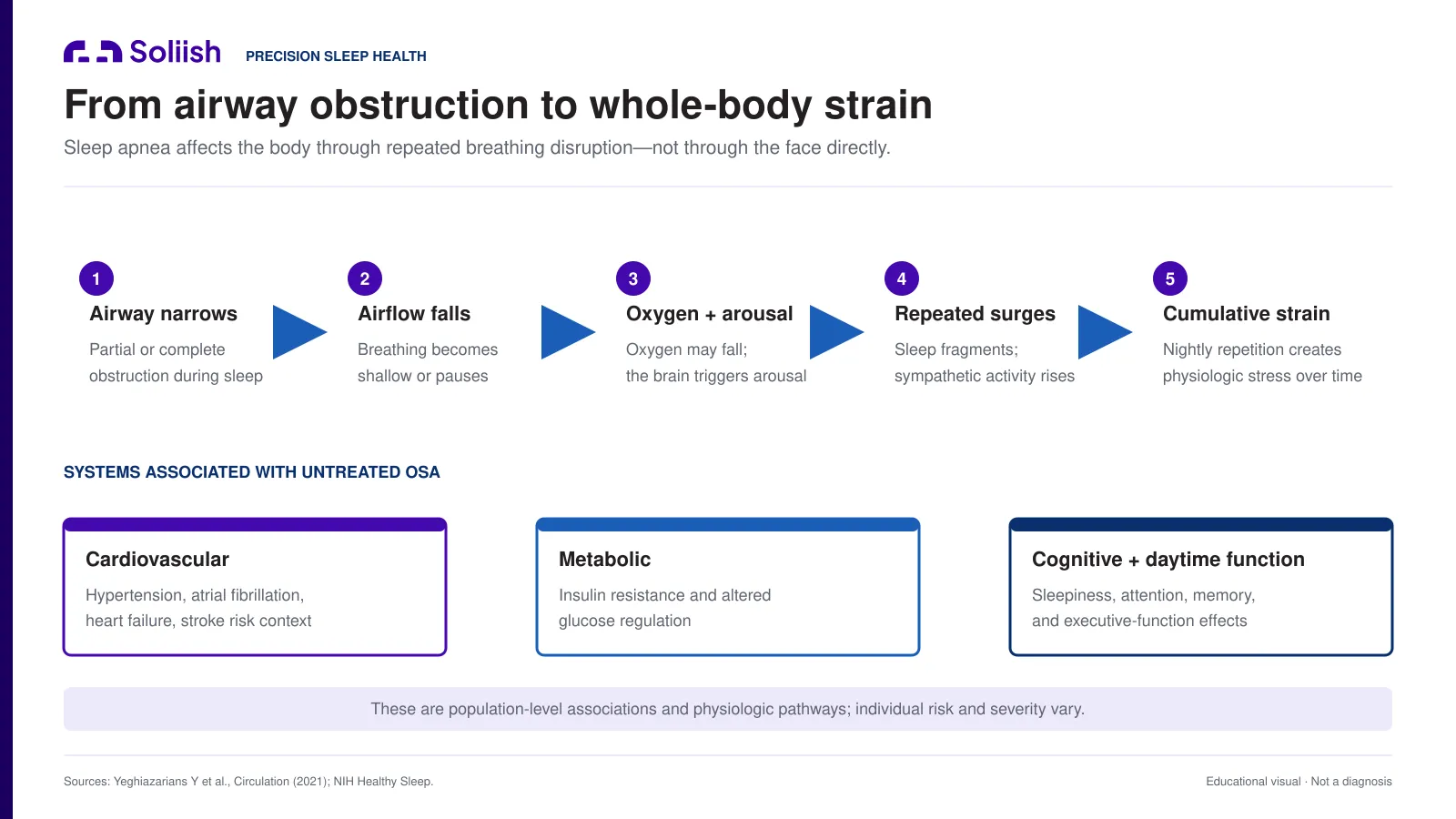
We often talk about sleep as time off. Biologically, it is an active state. Sleep supports cardiovascular function, metabolic regulation, immune activity, memory, and brain maintenance.²
When obstructive breathing repeatedly fragments sleep, the effects can extend beyond the airway. Intermittent drops in oxygen and repeated arousals activate physiological stress responses that are associated with cardiovascular disease³ and can affect daytime alertness and cognitive function.⁴
The scale is easy to underestimate. A 2019 modeling analysis estimated that 936 million adults aged 30–69 worldwide have mild-to-severe obstructive sleep apnea.⁵ Population studies also suggest that a large majority of clinically significant cases have not previously been diagnosed.³
That is the physiology and biology of sleep, and it is also the size of the care gap.
This is the gap Soliish was built for. If most people never start the journey, the most valuable thing technology can do is make starting easier. At Soliish, we see undiagnosed not as a dead end, but as the largest opportunity in sleep health.
Here is where Soliish chooses to be careful, because this is where our industry often gets carried away.
A face is not a heart test. A selfie cannot read blood pressure, blood sugar, or brain health. And a phone does not replace a clinical sleep study or a clinician’s judgment.
The face and the body are connected, but not directly in the way hype suggests. The connection runs through sleep. Facial structure can shape how we breathe at night. How we breathe at night can shape how the whole body recovers. Sleep is the hinge between the two.
The opportunity is not to infer whole-body health from a face. It is to use facial structure as one low-friction input for sleep-health awareness, then guide the person toward appropriate clinical evaluation.
That is the role Soliish is designed to play: not a diagnostic shortcut, but an engagement and connected-care platform that helps move people from curiosity to the right clinician and testing pathway.
Precision sleep health uses anatomy, physiology, symptoms, behavior, and treatment response to guide the right person toward the right evaluation and care pathway.
Put the three connections together and a different picture of sleep health appears. Not a single test or a single device, but a journey:
Today, most people fall out of this journey at step one. They never start.
Where Soliish is today:
FaceX supports the first stage - engagement and wellness-level education through a familiar selfie-based experience. It does not diagnose obstructive sleep apnea.
Where we are building:
FlowX is designed to connect the stages that follow, including referral, clinical evaluation, therapy coordination, and follow-through across sleep medicine, dental sleep medicine, diagnostic, and therapy partners.

So, could the future of precision health start with a selfie? I believe it can start there. The selfie is the front door, not the whole house. What matters is what is waiting on the other side.
The next leap in sleep health will not come from one more tracker or one more test. It will come from connecting the pieces that already exist, so fewer people fall through the gaps between them.
That work is bigger than any one company. It needs sleep physicians, dentists, ENT specialists, diagnostics partners, therapy makers, and payers pulling in the same direction.
If you are at HLTH USA 2026 and building anywhere along that journey, I would love to talk about where Soliish fits alongside what you are building. The face started as a way to prove who we are. Together, we can help it become a way to start caring for how we are.
HLTH USA 2026 takes place November 15–18 at The Venetian Expo in Las Vegas. If you are building in sleep medicine, dentistry, ENT care, diagnostics, therapy, or payer pathways, I would welcome a conversation about how we can connect awareness to evaluation and sustained care without asking any one company or product to carry the whole journey.