What if a face scan could assess OSA risk in seconds no hardware, no app downloads, no friction? The future of sleep health may already be here.
Obstructive Sleep Apnea (OSA) affects nearly 1 billion individuals globally, with the majority of moderate to severe cases remaining undiagnosed1. As a chronic condition associated with cardiovascular disease, metabolic disorders, and impaired cognitive and emotional functioning, OSA presents a widespread public health challenge one that too often goes unrecognized until symptoms significantly disrupt a patient’s quality of life.
Despite the scale of the problem, current screening tools fail to identify many at-risk individuals early. Now, advances in artificial intelligence (AI), facial biometrics, and clinical research are converging to transform how OSA is detected, shifting us toward more accessible, objective, and earlier identification.
Tools like the Epworth Sleepiness Scale (ESS) and the STOP-BANG questionnaire are common in primary care and sleep clinics, but they fall short in several ways:
This leaves a critical gap. Many people with anatomic risk factors for OSA remain undetected, which delays diagnosis and raises the risk of other health issues.
OSA is mainly a structural disorder. Airway blockage during sleep often comes from craniofacial anatomy. While obesity can play a role, anatomic traits are often not checked during screening.
Studies have linked elevated OSA risk to features such as:
In groups with lower obesity rates, these facial markers for sleep apnea may be the main drivers of airway collapse during sleep. That is why structural checks should be part of screening.
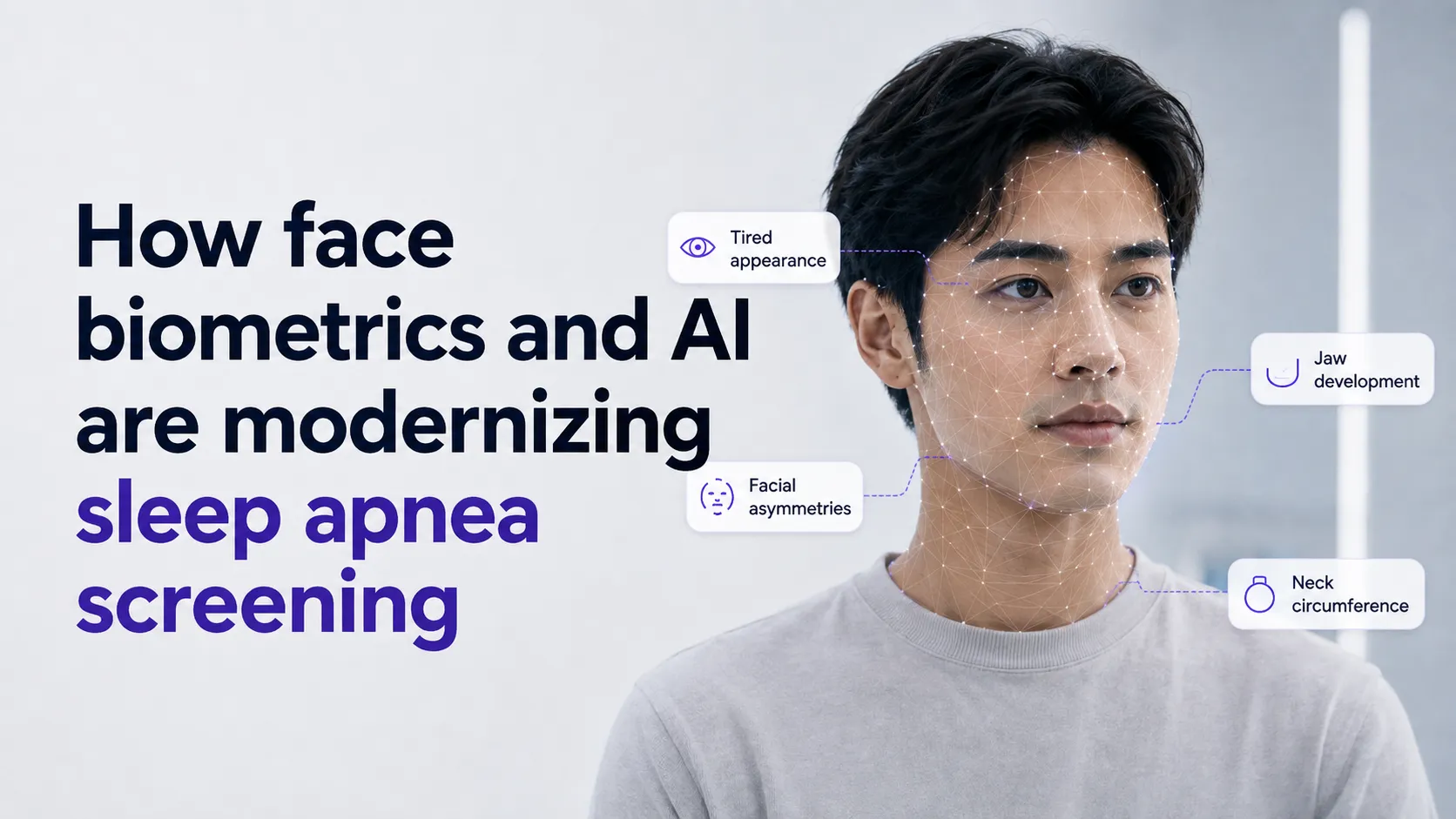
Thanks to AI and facial analysis, clinicians can now assess facial structure objectively and at scale.
A 2020 study in the Journal of Clinical Sleep Medicine found that facial geometry alone could predict OSA risk with 91% accuracy using deep learning trained on face images. That is better than most self-report tools.
This opens new possibilities:
In simple terms, the face becomes a measurable risk factor - no sleep diary or bed partner needed. A sleep apnea face scan can reveal useful clues before symptoms become obvious.
Late diagnosis comes with a high cost. Untreated OSA is linked to:
Earlier detection means earlier care, before other health issues and quality-of-life losses take hold.
At the center of this new model is FaceX, the AI-based OSA screening tool from Soliish.
With a simple selfie-style face capture no app download required FaceX uses advanced models trained on validated clinical data to look for facial markers for sleep apnea.
What sets it apart?
It works as a front-line triage tool. It can guide patients to the next step without adding strain to sleep labs or requiring overnight testing up front.
Because it is digital-first and non-invasive, FaceX can fit into:
This approach is especially useful for underserved communities, where access to traditional sleep care may be limited.
As sleep medicine evolves, it is clear that subjective screeners are not enough on their own. AI-driven facial analysis offers a strong, validated, and scalable add-on that recognizes the central role anatomy plays in OSA risk.
This is not about replacing diagnosis. It is about enabling earlier, more inclusive, and more efficient screening so care reaches people before symptoms take over their lives.
1. Benjafield, A. V., et al. (2019). Estimation of the global prevalence and burden of obstructive sleep apnoea. The Lancet Respiratory Medicine.
2. Chung, F., et al.(2016). STOP-BANG Questionnaire: A Practical Approach to Screen for Obstructive Sleep Apnea. Chest.
3. JCSM (2020). Facial Image Analysis and OSA Prediction Using Deep Learning. Journal of Clinical Sleep Medicine.
4. Li, Q., et al.(2021). Craniofacial phenotypes and risk for obstructive sleep apnea. Nature and Science of Sleep.


Traditional tools like the Epworth Sleepiness Scale and STOP-BANG questionnaire rely on self-reported symptoms. Those symptoms can change based on memory, awareness, and perception. They can also miss people who do not fit the usual profile, including non-obese patients or those with subtle symptoms.
OSA is often linked to structural airway blockage during sleep, and facial structure can affect how likely the airway is to collapse. Features such as recessed jaws, shorter lower facial height, fuller midface profiles, and larger neck circumference may point to higher risk, especially where obesity is less common.
No. The article presents AI-powered facial analysis as a screening and triage tool, not a replacement for diagnosis. Its job is to flag people who may be at higher risk and guide them to the next step before symptoms or complications become severe.
FaceX uses a selfie-style face capture to assess facial risk markers without an app download or overnight test at the start. Because it is digital-first and non-invasive, it can be used in virtual care intake, dental sleep consultations, preventive primary care, outreach campaigns, and other care settings.
Untreated OSA is linked to serious health and quality-of-life problems, including heart disease, stroke, atrial fibrillation, type 2 diabetes, depression, fatigue, cognitive decline, and lower workplace safety. Earlier screening can help people reach the right care before those problems grow worse.