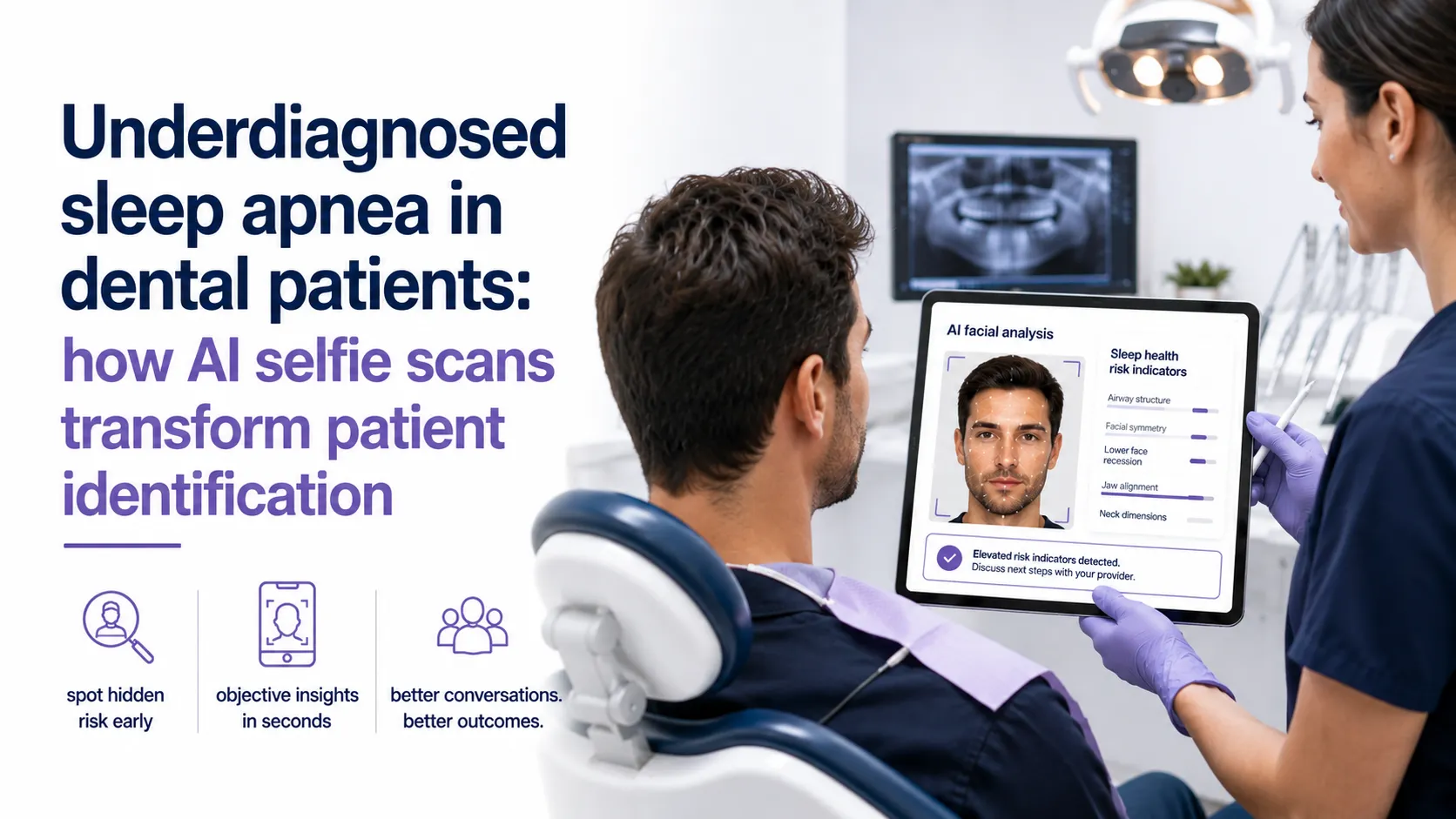
A patient sits down in the hygienist's chair for their routine cleaning. The dentist notices a scalloped tongue. A slightly retrognathic jaw.
A patient sits down in the hygienist's chair for their routine cleaning. The dentist notices a scalloped tongue. A slightly retrognathic jaw. Some enamel wear on the molars that suggests bruxism. The patient mentions, in passing, that their partner complains about snoring.
The signs are all there. The patient leaves. Nothing happens.
This is the quiet gap at the centre of sleep medicine. The patients most likely to have undiagnosed obstructive sleep apnea are not sitting in pulmonology waiting rooms. They are sitting in dental chairs, twice a year, in front of clinicians who see every relevant anatomical marker up close, and who have no structured way to act on what they see.
Dentistry sits in an unusual position. Dentists see patients more frequently than most primary care physicians. They examine the upper airway, the oral cavity, the jaw, and the soft tissues at every visit. They observe the exact anatomical features most correlated with OSA risk: retrognathia, narrow palatal arch, enlarged tongue volume, scalloped tongue margins, crowded dentition, class II occlusion.
Studies indicate that a meaningful proportion of adult dental patients, often cited in the 10 to 30 percent range depending on the population, carry craniofacial risk markers for OSA. Yet dental identification of these patients rarely translates into downstream diagnosis. The signal is visible. The pathway is broken.
 Schedule a demo now
An AI selfie scan for OSA changes identification in three specific ways. It is worth naming them precisely because "we added AI screening" has become a vague claim in dental marketing.
The clinical stakes here are not abstract. Untreated OSA is associated with hypertension, atrial fibrillation, heart failure, stroke risk, type 2 diabetes, depression, and cognitive decline. Patients identified earlier, treated earlier, and followed more consistently have better long-term outcomes across every one of those categories.
For the dental practice, earlier identification also changes the therapeutic window. A patient diagnosed at 42 with moderate OSA has decades of upstream risk still available to intervene on. Oral appliance therapy, where dentally indicated, becomes a relevant conversation. CPAP-intolerant patients have a referral pathway back to the dentist. The practice moves from incidental observer to active participant in the patient's long-term health.
Adding AI sleep apnea screening to a dental practice is not a matter of bolting a tool onto the existing workflow. It is a shift in what the practice can clinically see and do. Dental OSA identification stops being dependent on which hygienist is paying attention that day and starts being a baseline feature of every patient visit.
The dental profession has been positioned for years as a frontline OSA identification channel by both the American Dental Association and the American Academy of Dental Sleep Medicine. What has been missing is the infrastructure to make that positioning operationally real. AI selfie scanning, integrated into the intake workflow and paired with a closed-loop referral pathway, is that infrastructure.
If the patients most likely to have undiagnosed OSA are sitting in your dental chairs today, the question is not whether to screen. It is how to do it without adding a single step to the hygienist's day. That is the gap Soliish was built to close.
Find answers to frequently asked questions about our technology and services.
Sleep apnea is underdiagnosed across healthcare, but the gap is particularly visible in dentistry because most dentists observe strong anatomical risk markers at every visit without a structured way to identity patients, educate them on their risk and how dentist can help, document them, communicate them to patients, or close the referral loop with sleep provider to make it easy to treat patients. Research suggests roughly 80 percent of adults with moderate to severe OSA remain undiagnosed, and many of those patients are regular dental attendees.

Dentists routinely observe several orofacial and airway markers associated with elevated OSA risk, including retrognathia, narrow palatal arch, enlarged or scalloped tongue, crowded dentition, class II occlusion, and enamel wear consistent with bruxism. An AI face scan for dentists reads these facial features linked to obstructive sleep apnea objectively and produces a risk score that supports clinical follow-up.
Traditional screening tools like STOP-BANG, ESS rely on self-reported symptoms and BMI, which systematically underperform in women and in populations with smaller jaw anatomy at normal body weight. An AI selfie scan reads craniofacial markers directly, independent of self-report, which surfaces patients who would not flag on questionnaire-based screening alone.
No. An AI selfie scan is a screening and triage tool to engage patients and efficiently educate them that their facial and other orofacial markers are linked to something more serious than snoring, fatigue or not getting enough sleep. Dentists do not diagnose OSA. Informed Patients identified as elevated risk are guided toward appropriate diagnostic testing, typically a home sleep test or referral to a sleep physician. They are responsible for diagnosing patients for OSA and prescribing therapy including oral appliance therapy which a dentist can provide care. This pathway is consistent with American Dental Association (ADA) and American Academy of Dental Sleep Medicine (AADSM) guidance.
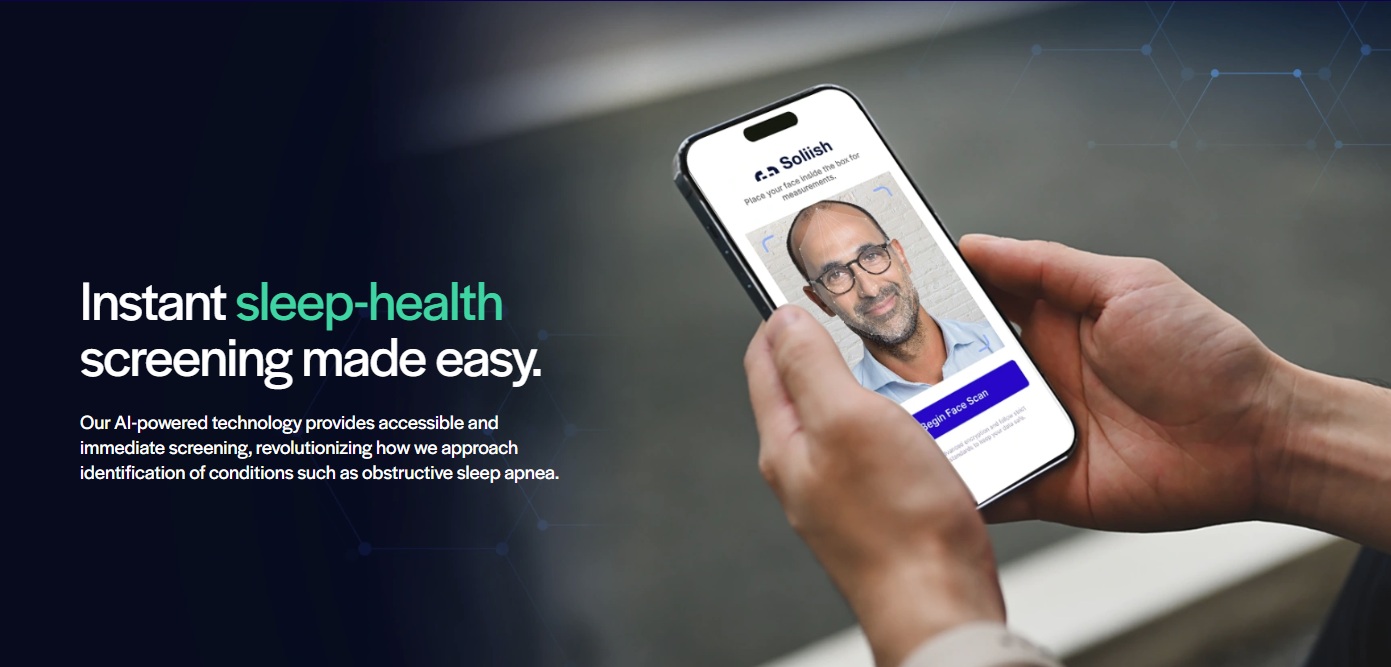
The Soliish AI selfie scan for obstructive sleep apnea is patient-completed on any smartphone or browser. Patients can initiate at the time of check-in, at home or in a clinic with a simple QR code scan in waiting room, during the hygiene visits while in the chair. It seamlessly integrates into the workflow, requires no hardware, and is HIPAA compliant with EHR integration. Scan results and referral actions are captured automatically into a portal and can be integrated into the dental practice management system, so identification and documentation happen without adding staff burden. Patients can then be directed to local sleep clinic or there is also a convenient option for Dentist team or patients to schedule a virtual appointment with nationally licensed, board certified sleep clinic partners, so they can get diagnosed and be prescribed therapy if they need one. The platform helps track patient journey and support longitudnal care, follow-up titration studies to help improve compliance and patient outcomes with oral appliance therapy.