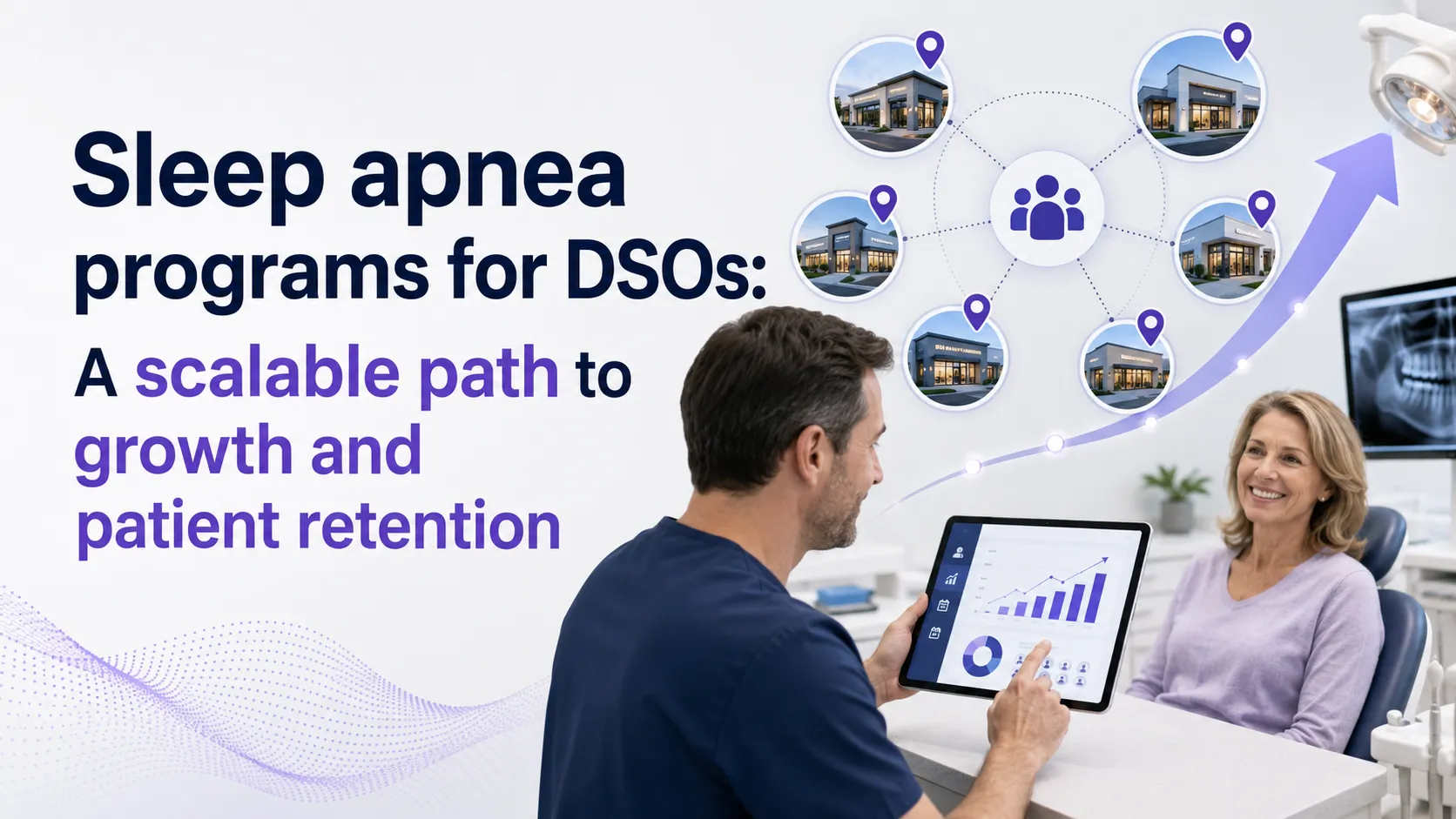
Dental sleep medicine is one of the strongest service line opportunities for DSOs. Here is the strategic case, the operational reality, and the path to scale.
Dental sleep medicine is a strong service-line opportunity for DSOs.
The clinical need is clear. Sleep-related breathing disorders are common, and many patients remain unidentified. The business case is also strong. Oral appliance therapy can support patient retention, longitudinal care, and new revenue opportunities when implemented responsibly.
Yet many DSOs struggle to scale dental sleep medicine beyond a few motivated locations.
The issue is rarely clinical interest. It is workflow.
To make dental sleep medicine work across a DSO, leaders need more than training and enthusiasm. They need standardized screening, referral coordination, medical collaboration, billing support, reporting, and visibility across the patient journey.
Why is dental sleep medicine a strong opportunity for DSOs?
Dental sleep medicine fits the DSO model because DSOs have patient volume, centralized operations, clinical leadership, training infrastructure, and reporting systems that can support scalable sleep-health workflows.
Dental sleep medicine can be difficult for a solo practice to build from scratch.
A DSO is different.
DSOs already have many of the systems needed to scale a new clinical workflow across multiple locations. That includes centralized leadership, training teams, operational playbooks, technology infrastructure, and performance reporting.
The opportunity comes from three areas.
First, DSOs see large patient populations. Even a modest screening workflow can identify many patients who may benefit from a sleep-health conversation.
Second, DSOs can standardize workflows. They can build one process, train it across locations, and refine it over time.
Third, dental sleep medicine creates long-term patient engagement. Oral appliance therapy, when appropriate after medical evaluation, involves follow-up, titration, monitoring, and replacement cycles.
For DSOs, that creates a service line that can support both patient care and business growth.
Most DSO sleep apnea programs fail because they are launched as clinical initiatives instead of operational programs.
That difference matters.
A clinical initiative depends on individual provider interest. One dentist champions it. One hygienist remembers to ask. One location builds a local referral relationship.
That can work in a single office.
It does not scale well across 30, 50, or 100 locations.
When each location creates its own process, the program becomes inconsistent. One office uses a questionnaire. Another relies on chairside observation. A third has no clear workflow. Referral pathways vary. Documentation differs. Leadership cannot see what is happening.
The result is predictable.
Screening rates vary. Referrals leak. Patients drop off. Oral appliance therapy volume stays concentrated in a few locations.
The DSO may have launched a program on paper, but it has not built a scalable system.
A scalable dental sleep program needs to be built into the operating model.
That means the workflow should not depend on a single motivated dentist or office manager.
It should be clear enough for every location to run.
A scalable program usually includes:
The goal is consistency.
Each location should know what to do when a patient reports snoring, fatigue, morning headaches, dry mouth, or other sleep-health concerns.
Each team should understand what they can say, what they should document, and when to route the patient for further evaluation.
Dental sleep medicine can support several executive priorities.
Revenue diversification
DSOs often look for ways to grow beyond traditional dental service lines.
Dental sleep medicine can create incremental revenue from patients already in the practice. That reduces reliance on new patient acquisition alone.
Patient retention
Sleep-health workflows can create ongoing engagement.
Patients may return for education, evaluation coordination, oral appliance therapy following medical evaluation, appliance adjustments, monitoring, and replacement.
That can strengthen long-term patient relationships.
Brand differentiation
Sleep health is becoming a bigger conversation for patients, providers, and employers.
A DSO that supports sleep-health conversations in a clear, responsible way can stand out from practices that do not address the topic at all.
Clinical alignment
Dentists already observe oral, craniofacial, and airway-related anatomy.
An ADA-aligned sleep-health workflow gives teams a structured way to connect those observations to patient education and appropriate next steps.
Operational visibility
When the workflow is centralized, leadership can measure performance across locations.
That visibility helps leaders understand what is working, where patients are dropping off, and which teams need support.
Scaling dental sleep medicine requires five core components.
1. A standardized screening process
The front end of the workflow has to be consistent.
Every location should use the same process to start sleep-health conversations. This may include digital intake questions, facial analysis, patient education, or a structured chairside workflow.
The process should be simple, documented, and easy for the team to repeat.
If screening depends on memory or personal interest, it will not scale.
2. A unified referral pathway
A sleep-health conversation needs a clear next step.
Patients identified as having possible elevated risk should be guided toward appropriate medical evaluation. That may involve local sleep physicians, regional partners, or tele-sleep providers.
Without a consistent referral pathway, patients fall through the cracks.
For DSOs, centralized referral infrastructure can help reduce location-by-location variation.
3. A defined oral appliance therapy workflow
Oral appliance therapy should be handled carefully and collaboratively.
The workflow should define how patients move from medical diagnosis and prescription to dental evaluation, appliance fitting, titration, follow-up, and monitoring.
This includes:
The dentist’s role is important, but it should sit within a coordinated care model.
4. Medical billing support
Oral appliance therapy is often billed through medical insurance, not dental insurance.
This is one of the biggest operational gaps for practices and DSOs entering dental sleep medicine.
Leaders need to decide whether billing will be handled in-house, outsourced, or supported through a hybrid model.
The key is consistency.
Every location should not have to solve medical billing on its own.
5. Reporting and visibility
A scalable program needs a reporting layer.
Leadership should be able to track:
Without this visibility, the program is hard to manage.
With it, leaders can refine the workflow, support teams, and make better rollout decisions.
The timeline depends on the size of the organization and the maturity of its existing systems.
A common path starts with a pilot.
For many DSOs, that means testing the workflow in two or three locations for 30 to 60 days. The pilot helps leadership understand what the screening rate looks like, how patients respond, how referrals move, and where the process needs improvement.
After that, the DSO can refine the workflow and roll it out in waves.
A mid-sized DSO may expand across the network over several months if training, technology, and referral infrastructure are already in place.
Larger DSOs may need more time because change management is more complex.
The biggest factor is leadership alignment.
Programs move faster when clinical, operational, and executive teams treat dental sleep medicine as a strategic service line, not a side project.
 Schedule a demo now
The American Dental Association recognizes a role for dentists in sleep-related breathing disorders.
The ADA encourages dentists to screen patients for sleep-related breathing disorders as part of a comprehensive medical and dental history. It also recognizes the dentist’s role in oral appliance therapy when prescribed by a physician.
For DSOs, this matters for two reasons.
First, it supports the idea that sleep-health conversations are appropriate within dentistry.
Second, it reinforces the need for collaboration.
The dentist can support identification, education, and oral appliance therapy when appropriate. The physician or qualified medical provider handles diagnosis. Follow-up should happen through a coordinated care pathway.
This is exactly the kind of workflow DSOs are built to operationalize.
Successful DSO sleep programs tend to share a few traits.
They have executive support.
They standardize the screening process early.
They centralize referral pathways instead of leaving each location to build its own.
They create training that works for dentists, hygienists, and administrative teams.
They solve the billing workflow before scaling.
They measure performance from day one.
They treat dental sleep medicine as infrastructure, not a campaign.
That last point is important.
A campaign creates a burst of activity. Infrastructure creates repeatable performance.
Dental sleep medicine needs the second one.
Soliish is a facial-analysis-driven engagement and workflow platform purpose-built for sleep-health workflows in dental practices.
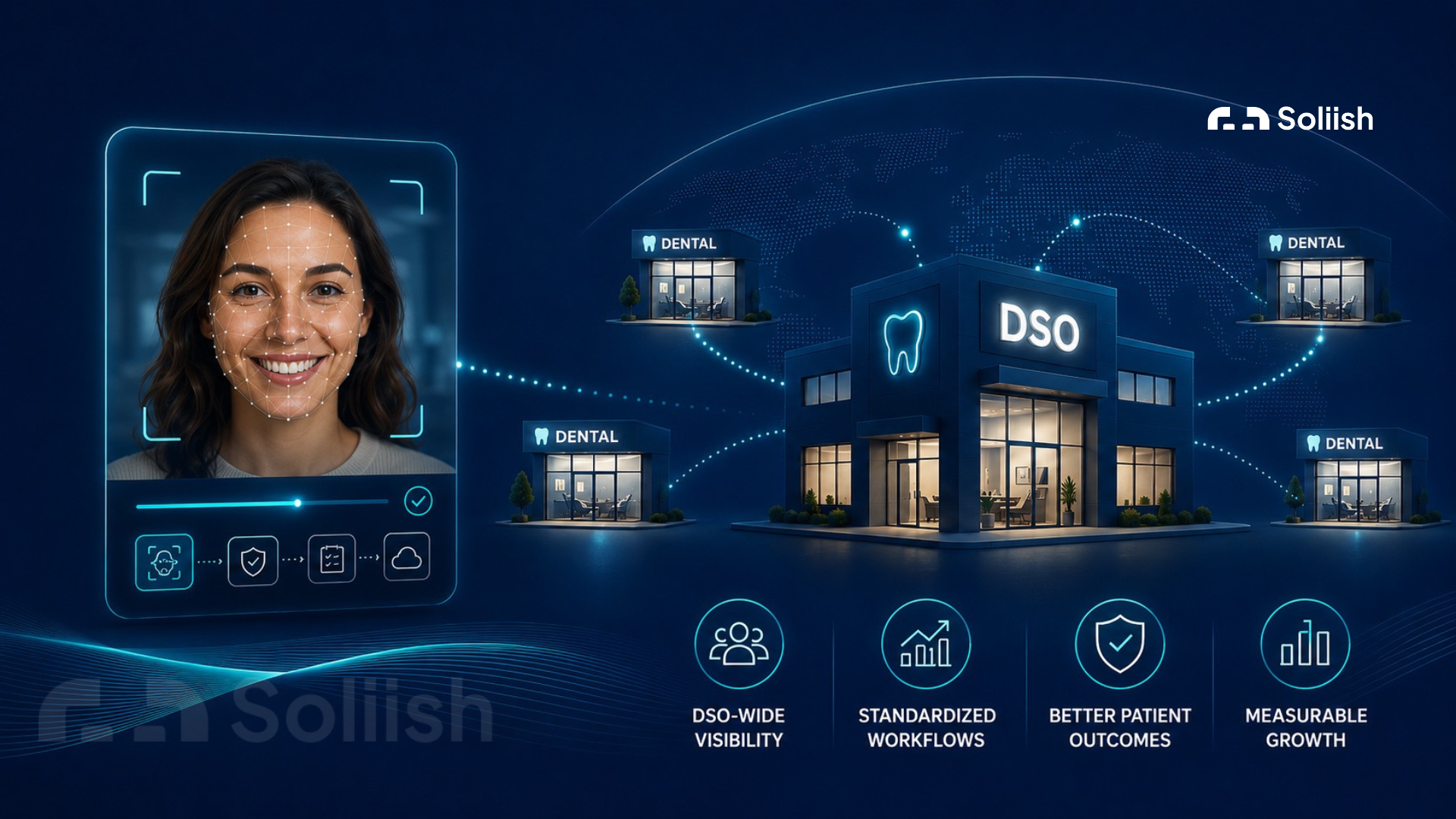
The platform combines a selfie-based AI scan that reads orofacial and airway-related facial traits with an integrated workflow layer. The workflow layer handles patient engagement, referral coordination, and documentation across the patient journey.
For DSOs, Soliish supports the operational layer needed to make dental sleep medicine scalable.
The platform helps dental organizations screen patients for sleep apnea risk in a consistent, repeatable way at every location. It then routes elevated-risk patients into a coordinated care pathway that ends, where clinically appropriate, in oral appliance therapy (OAT) delivered by a dentist trained in dental sleep medicine.
The platform helps DSOs:
This matters because most DSO sleep programs do not stall because the clinical opportunity is weak. They stall because the workflow is inconsistent.
The screening varies by location. Patients fall out of the referral pathway. Documentation is fragmented. Leadership cannot see what is happening across the network.
Soliish helps bring structure to the front end of the patient journey, where many programs struggle most.
By combining a standardized selfie-based screening tool that reads orofacial and craniofacial markers associated with airway-related sleep apnea risk, with an integrated workflow that supports referral coordination and patient engagement, the platform addresses the operational layer.
That is what turns dental sleep medicine from a clinical initiative into a managed program at scale.
A focused pilot is usually the best first step.
Rather than trying to roll out a full dental sleep medicine program across the entire network at once, a DSO can start with two or three locations.
The pilot should answer practical questions:
This gives leadership real data.
It also gives the organization time to refine training, referral coordination, documentation, and follow-up before scaling.
The goal of a pilot is not perfection.
The goal is to learn what works well enough to scale.
Dental sleep medicine is a strong fit for the DSO model, but only when it is treated as an operational program.
The opportunity is real. DSOs have the patient volume, training infrastructure, reporting capabilities, and centralized leadership to support sleep-health workflows across locations.
But the program must be standardized.
Screening, referral coordination, oral appliance therapy workflows, billing support, and reporting all need to work together.
Soliish supports this by helping DSOs build a more consistent front end for sleep-health engagement.
If your DSO is evaluating dental sleep medicine as a service line, start with the workflow.
That is where scale begins.


Dental sleep medicine fits the DSO model because DSOs have large patient populations, centralized operations, training systems, and reporting infrastructure. These strengths make it easier to standardize sleep-health workflows across locations.
Many programs fail because they depend too heavily on individual clinician interest. Without standardized screening, referral pathways, training, billing support, and reporting, the program becomes inconsistent across locations.
Dentists can support sleep-health conversations by identifying symptoms and observing oral, craniofacial, and airway-related anatomy. Patients who may be at risk should be guided toward appropriate medical evaluation.
DSOs with trained dental sleep medicine providers may support oral appliance therapy when it is prescribed by a physician and appropriate for the patient. The workflow should include medical collaboration, documentation, fitting, titration, and follow-up.
No. Facial analysis does not diagnose sleep apnea. Soliish helps identify facial traits associated with elevated sleep apnea risk and supports patient education and appropriate evaluation pathways.
Soliish supports DSOs by standardizing facial-analysis-driven patient engagement, improving referral visibility, supporting coordinated care pathways, and helping practices improve visibility across the patient journey.
A DSO pilot should track screening volume, patient engagement, elevated-risk identification, referral conversion, evaluation completion, oral appliance therapy activation following medical evaluation, and location-level workflow performance.
The best first step is usually a focused pilot in a few locations. This allows the organization to test the workflow, train teams, collect data, and refine the model before scaling across the network.